The Great Mindfulness Sutra (English)

Welcome

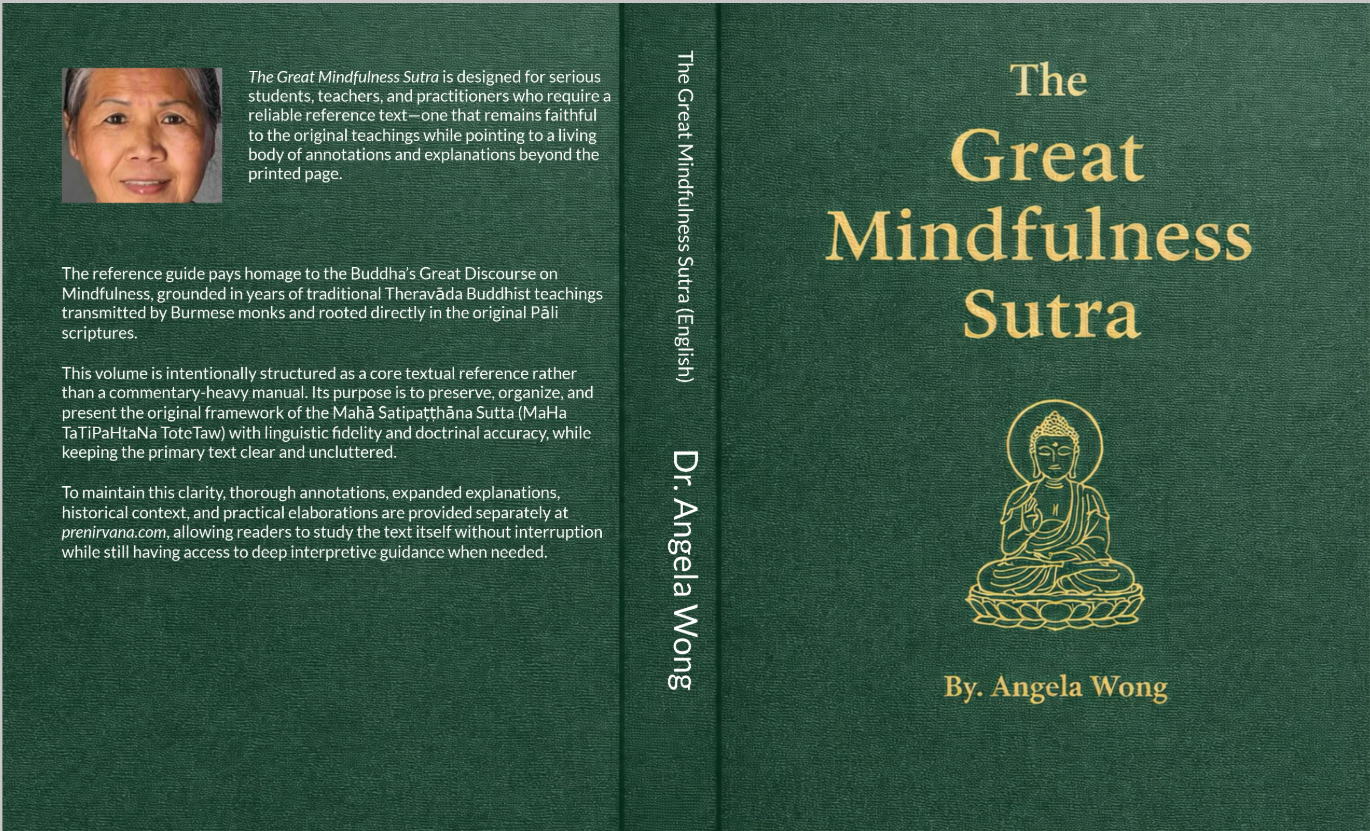
Welcome to the digital edition of The Great Mindfulness (MaHa TaTiPaHtaNa ToteTaw). This book, carefully compiled by Dr. Angela Fan-Lan Wong, serves as a "small lamp" for those walking the path toward liberation and enlightenment.


Cover

As you navigate these pages for the first time, you are invited to explore the profound and subtle teachings of the Buddha, structured to help you understand the true nature of existence through the lens of Abhidhamma and Vipassana meditation.

How to use this guide

This book is not intended to establish new views or persuade, but to arrange the Dhamma clearly for your quiet contemplation. As the author suggests, do not accept the teachings hastily nor reject them prematurely.

Instead:

  1. Quietly: Take time with the diagrams and definitions.
  2. Within: Compare these teachings with your own meditative experience.
  3. Cultivate mindfulness: Use these pages as a roadmap to see the "arising and passing away" of all things more clearly.

May this digital companion illuminate your practice and help you correctly understand the true meaning and purpose of the Buddha’s sublime Dharma.


With palms joined,


Dr. Angela Fan-Lan Wong

The Great Mindfulness ToteTaw (MaHa TaTiPaHtaNa)

Page 1

Page 1

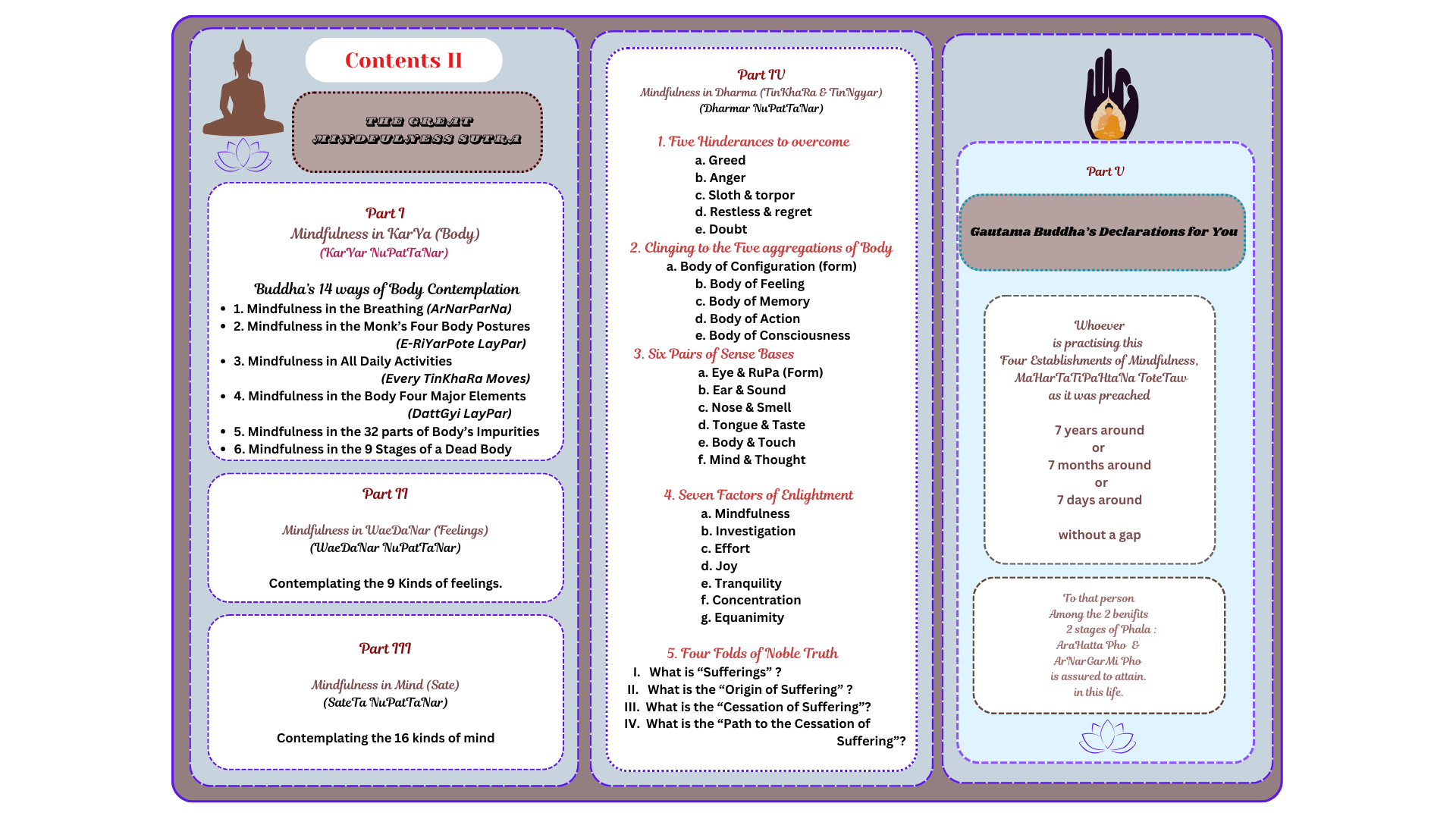
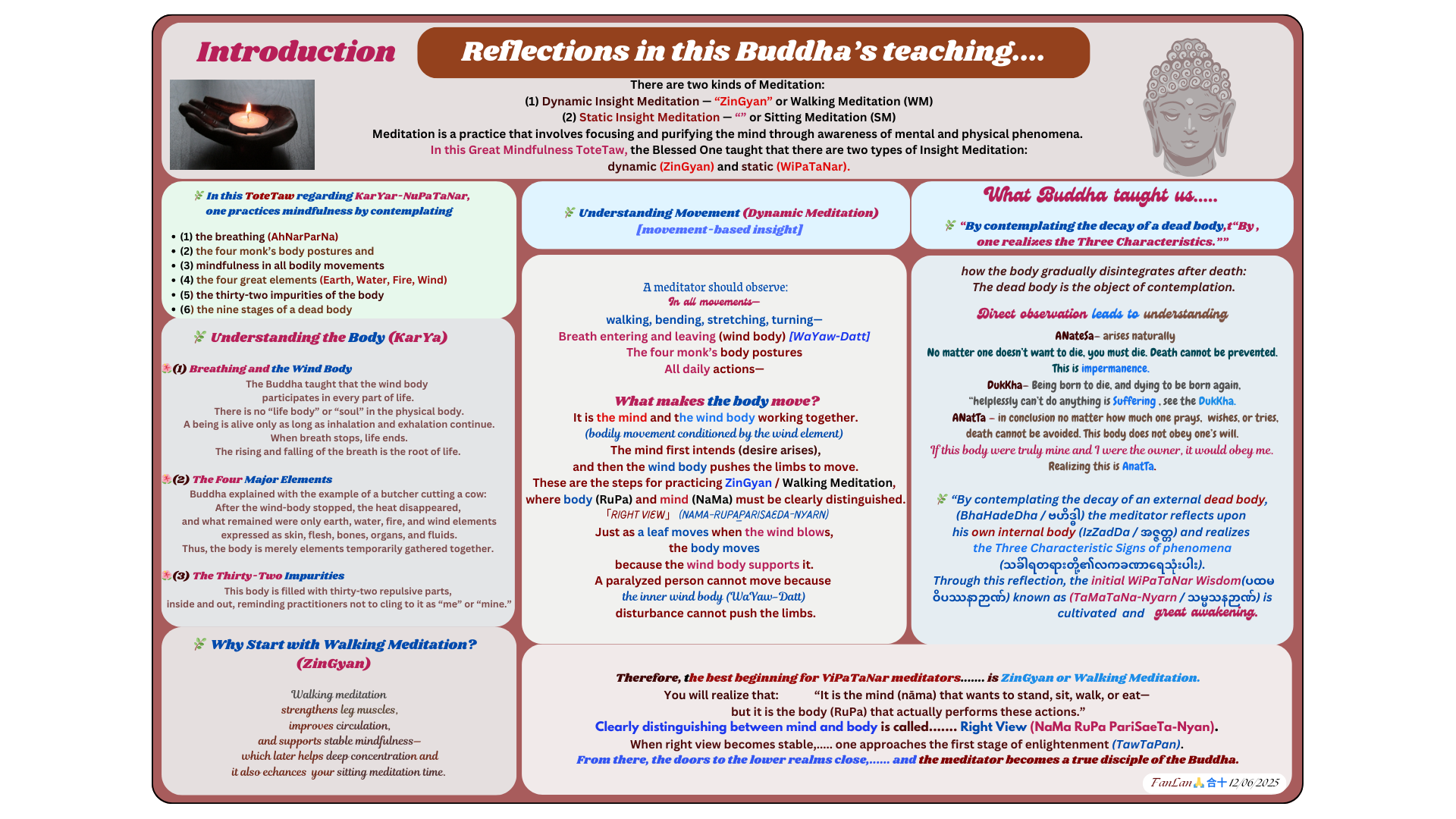
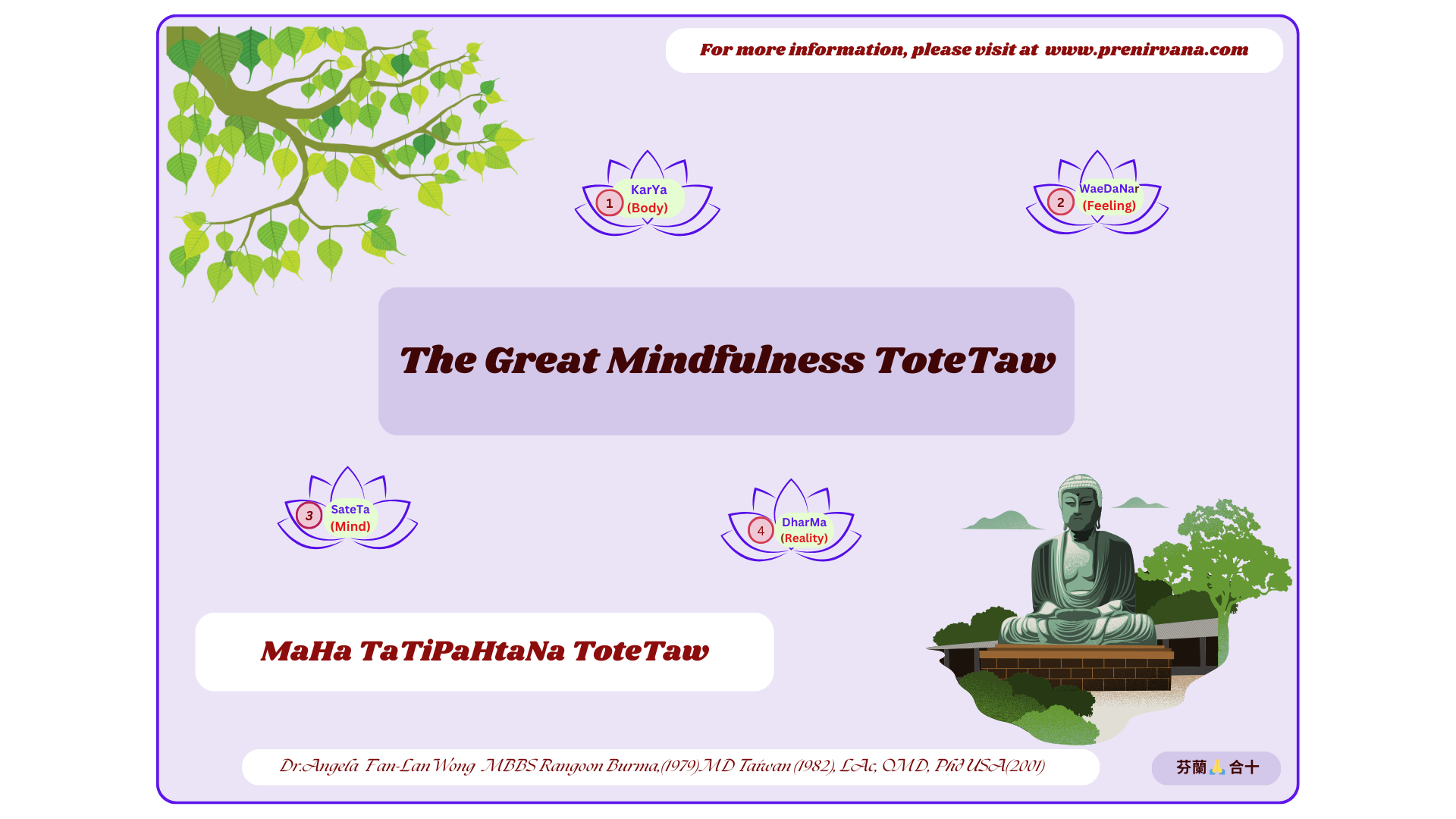
The Great Mindfulness ToteTaw focuses on the four foundations of mindfulness as the core of the Buddha's teachings. This work is compiled to help practitioners understand the direct path to liberation.

  1. KarYa: Contemplation of the Body
  2. WaeDaNar: Contemplation of Feeling
  3. SateTa: Contemplation of the Mind
  4. DharMa: Contemplation of Reality
Author’s Note: A Mission of Care and Clarity

Page 2

Page 2

This book was written not to persuade or display understanding, but to gather the Buddha's original teachings with care and arrange them clearly without personal bias.

  1. The goal is to avoid distorting the Dhamma or misleading future practitioners.
  2. The author expresses a wish to finish this work with care as a "small lamp" for those in darkness.

Structure and Contents of the Handbook

Page 3

Page 3

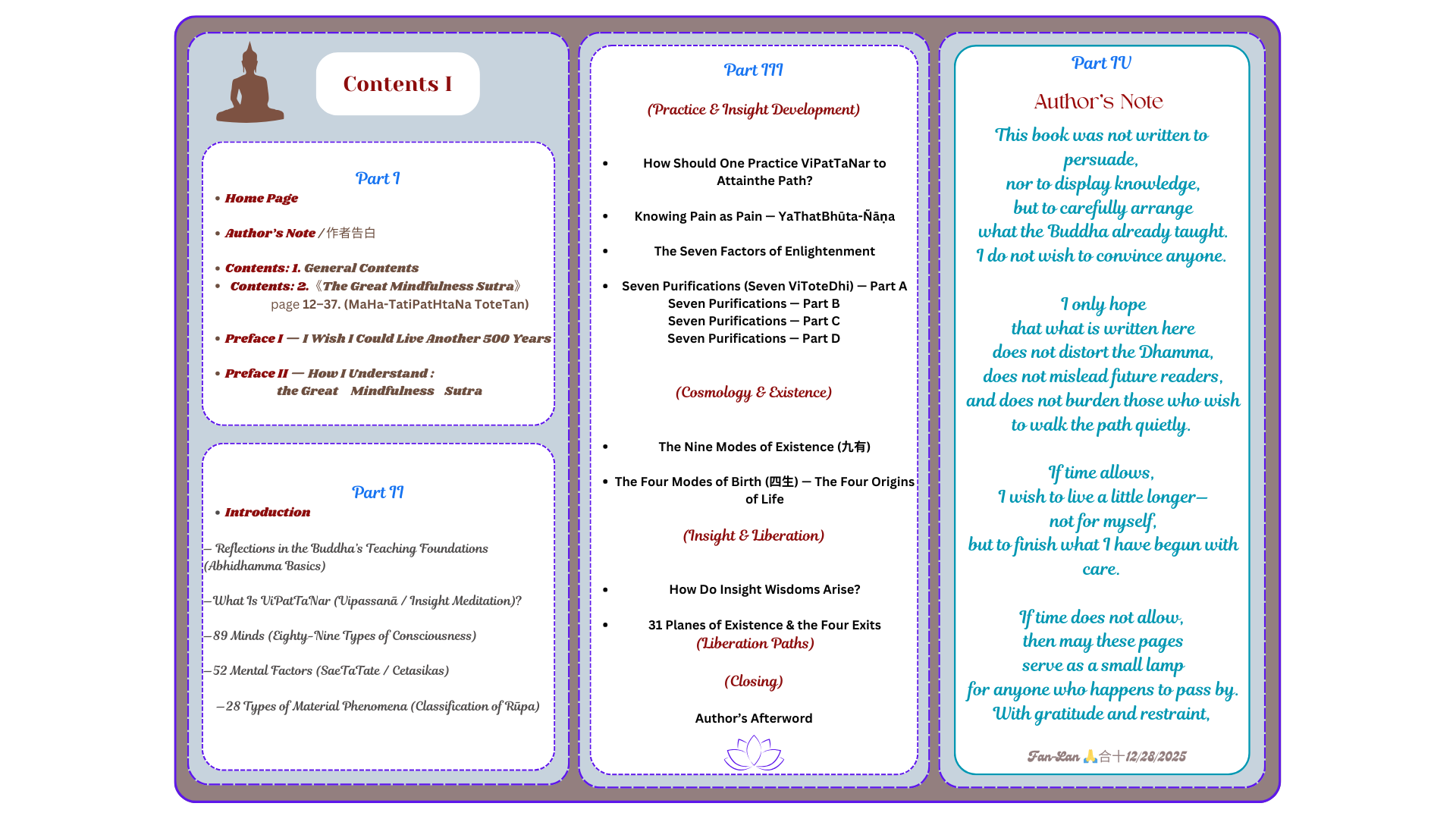
The book is organized into several parts covering the basics of Abhidhamma, the practice of insight meditation, and the path to liberation.

  1. Part II contains the Great Mindfulness Sutra (pages 12–37).
  2. Includes introductions to the 89 types of consciousness and 52 mental factors.
  3. Covers the Seven Purifications and the 31 Planes of Existence.

The Five Hindrances and Buddha’s Declarations

Page 4

Page 4

This section outlines the obstacles to enlightenment and the specific declarations made by Gautama Buddha regarding the effectiveness of mindfulness practice.

  1. Lists the Five Hindrances: Greed, Anger, Sloth & Torpor, Restlessness & Regret, and Doubt.
  2. The Buddha declared that practicing the Four Establishments of Mindfulness consistently for seven years, months, or even days can lead to liberation.

Preface: A Ten-Year Vow and the Three Stages of Life

Page 5

Page 5

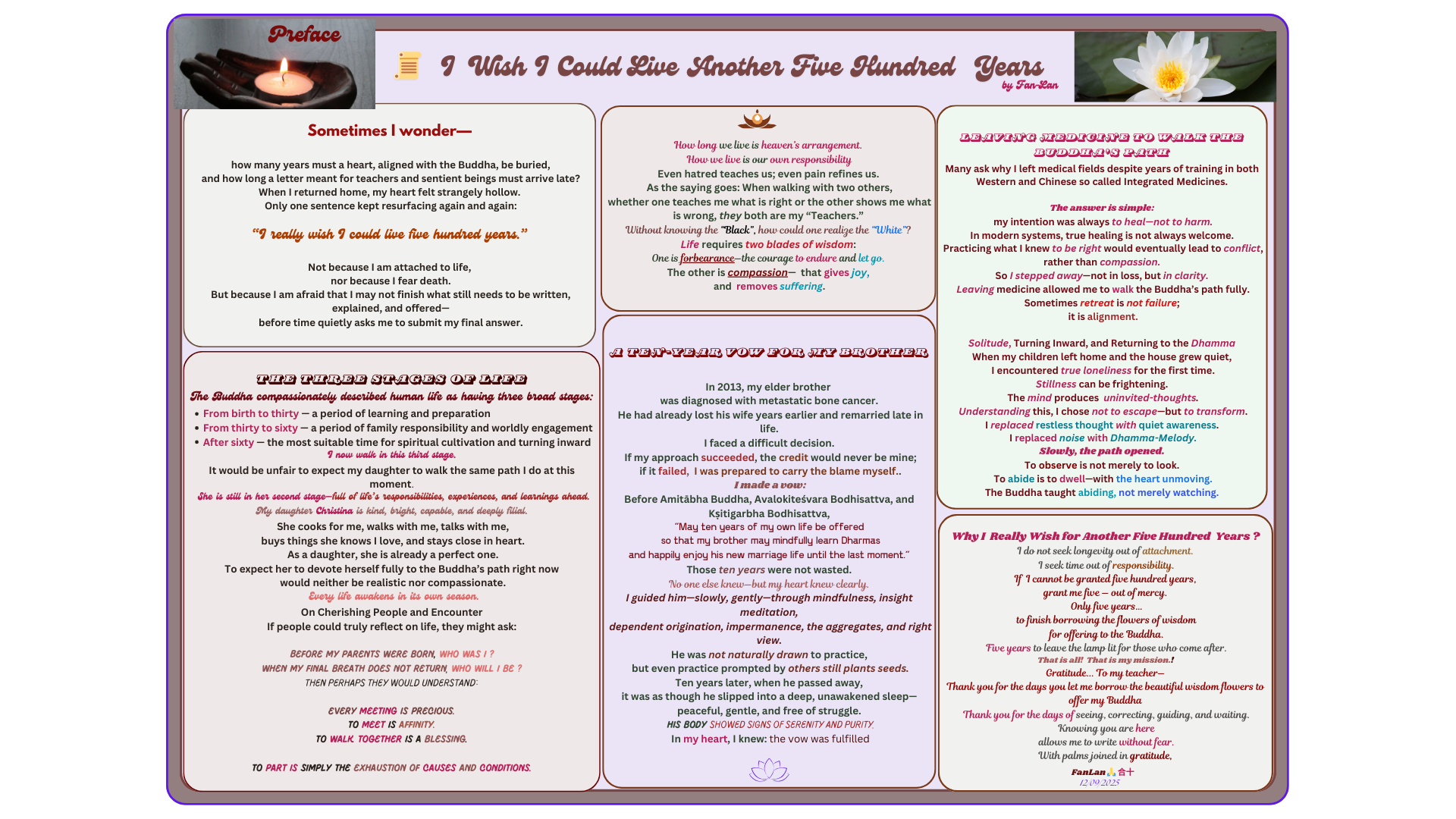
The author reflects on the stages of human life and shares a personal story regarding a ten-year vow made for her brother's mindful transition during his battle with cancer.

  1. Life after sixty is described as the most suitable time for spiritual cultivation and turning inward.
  2. The author views completing this work as a responsibility and a way to leave a "lamp lit" for others.

Understanding the Great Mindfulness Sutra (EAP System)

Page 6

Page 6

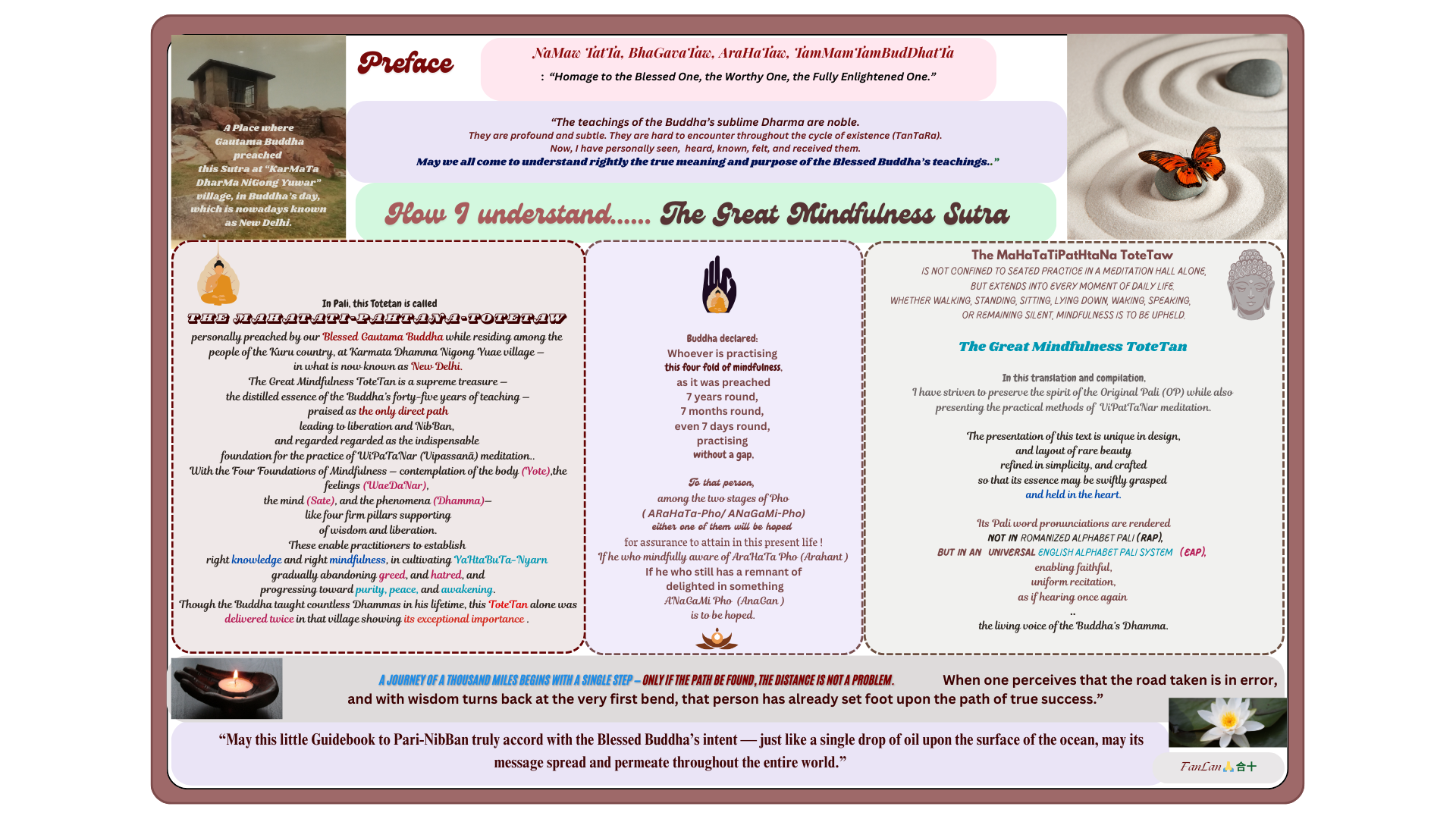
The MaHaTaTi-PaHtaNa-ToteTaw is the distilled essence of the Buddha’s 45 years of teaching and is considered the only direct path to liberation.

  1. Utilizes a unique Universal English Alphabet Pali (EAP) system for faithful recitation.
  2. Emphasizes that mindfulness must be maintained in every moment of daily life, not just during seated meditation.

Walking Meditation and the Distinction of Mind and Body

Page 7

Page 7

Walking meditation (ZinGyan) is presented as the best starting point for insight meditation because it clearly shows the interaction between mind and body.

  1. The mind (NaMa) intends to move, and the wind element (WaYaw-Datt) pushes the body (RuPa) to perform the action.
  2. Distinguishing between mind and body is the foundation of Right View (NaMa RuPa PariSaeTa-Nyan).

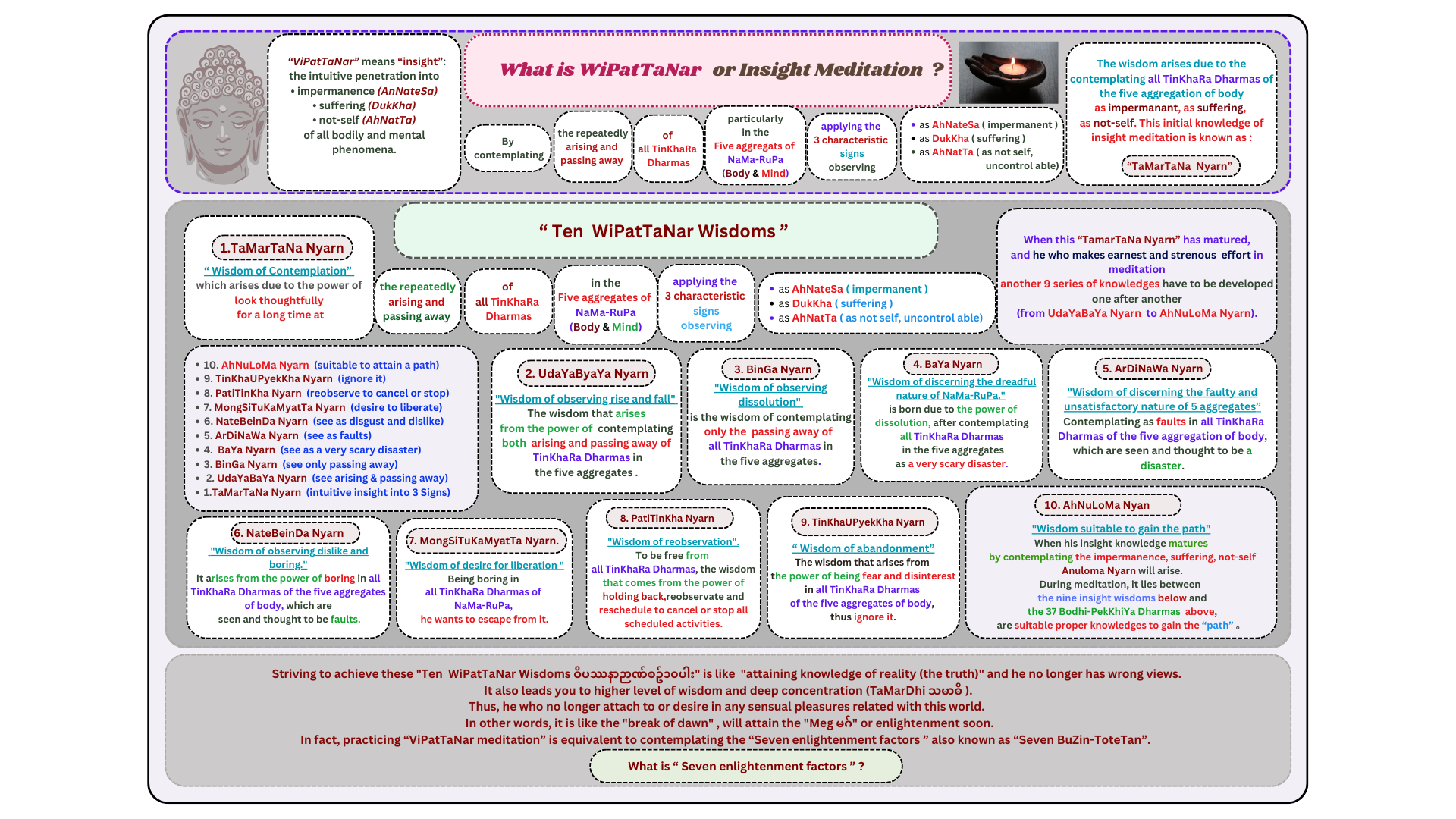
The Ten Insight Wisdoms (WiPatTaNar)

Page 8

Page 8

Insight involves the intuitive penetration into the three characteristics of existence: impermanence, suffering, and not-self.

  1. The progression begins with TaMarTaNa Nyarn (discerning the faults of the five aggregates).
  2. It moves through stages such as observing rise and fall (UdaYaBaYa Nyarn) and dissolution (BinGa Nyarn).
  3. The path culminates in AhNuLoMa Nyarn, the wisdom suitable for attaining enlightenment.

The 89 Minds and the Supramundane Paths

Page 9

Page 9

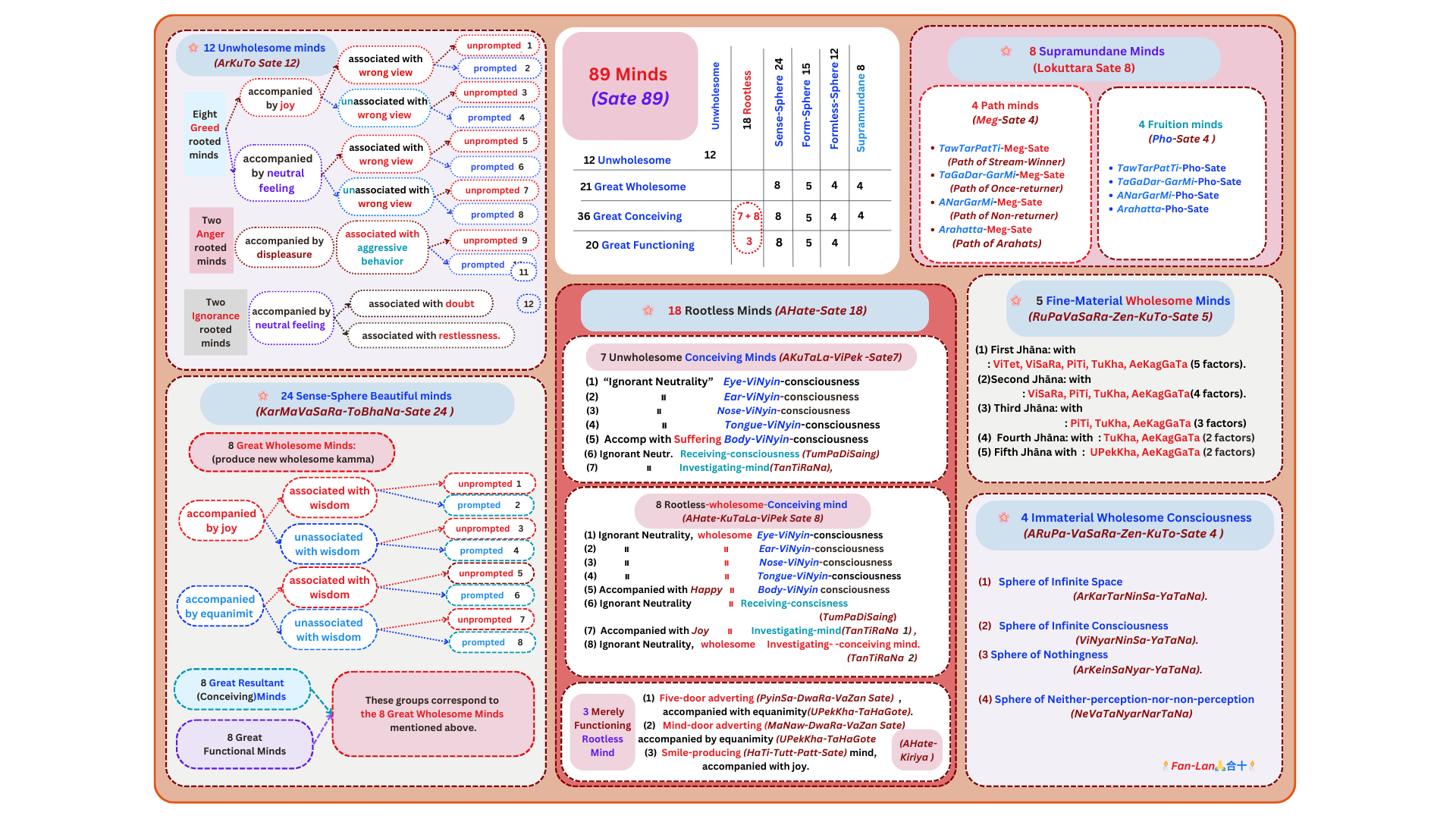
The document provides a detailed classification of the 89 types of consciousness, ranging from unwholesome states to the highest supramundane minds.

  1. Includes 12 unwholesome minds (greed, anger, and ignorance rooted).
  2. Describes the 8 Supramundane Minds (Lokuttara Sate) consisting of the 4 Path minds and 4 Fruition minds.

The 52 Mental Factors (SaeTaTate)

Page 10

Page 10

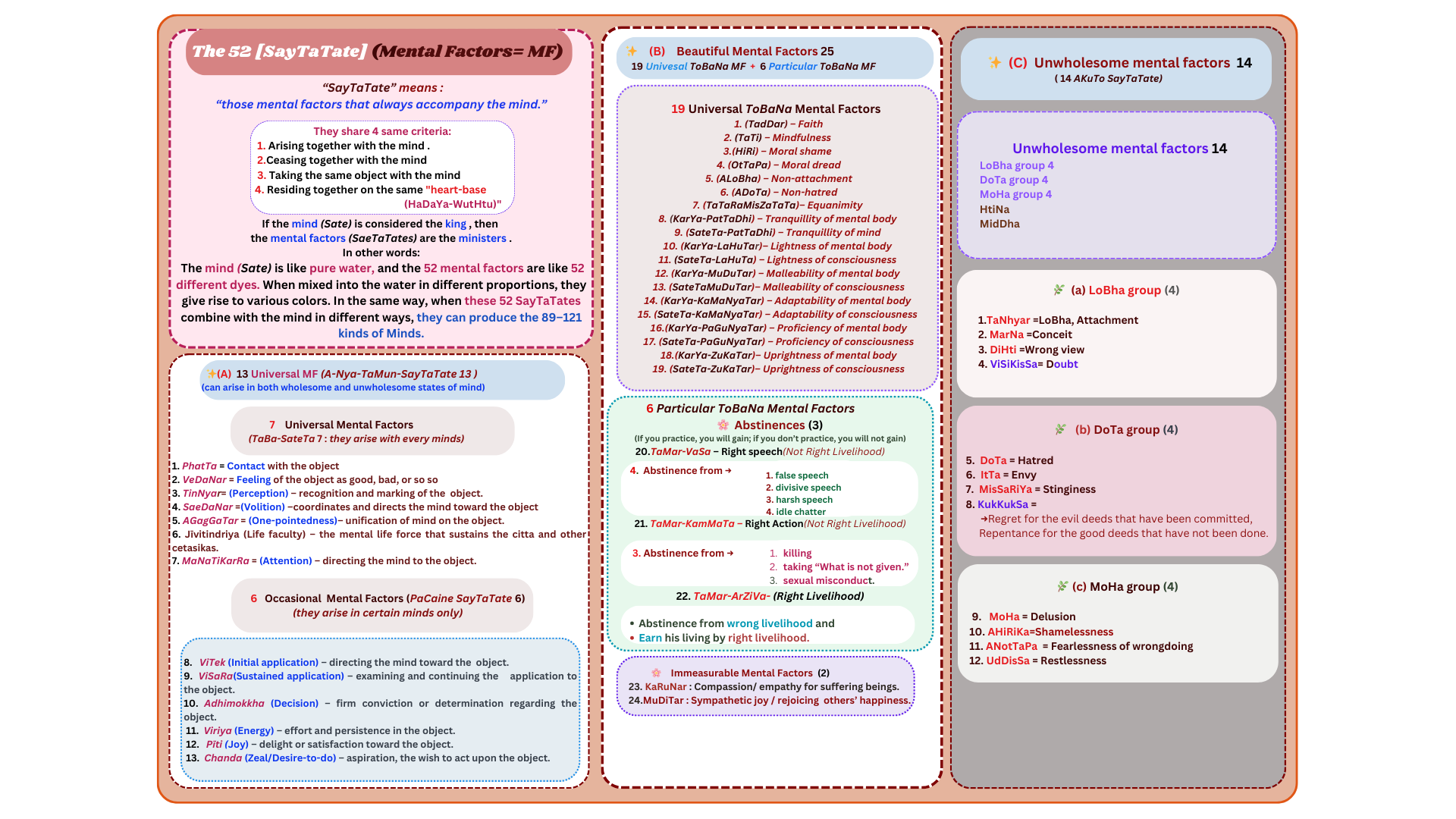
Mental factors are compared to dyes that color the "pure water" of the mind, defining the nature of each thought or state of consciousness.

  1. Universal factors include contact (PhatTa), feeling (VeDaNar), and perception (TinNyar).
  2. Unwholesome groups include the LoBha (Greed), DoTa (Anger), and MoHa (Delusion) groups.
  3. Beautiful factors include Wisdom (PyinNyinDaRay), which represents non-delusion.

The 28 Classifications of Rupa (Materiality)

Page 11

Page 11

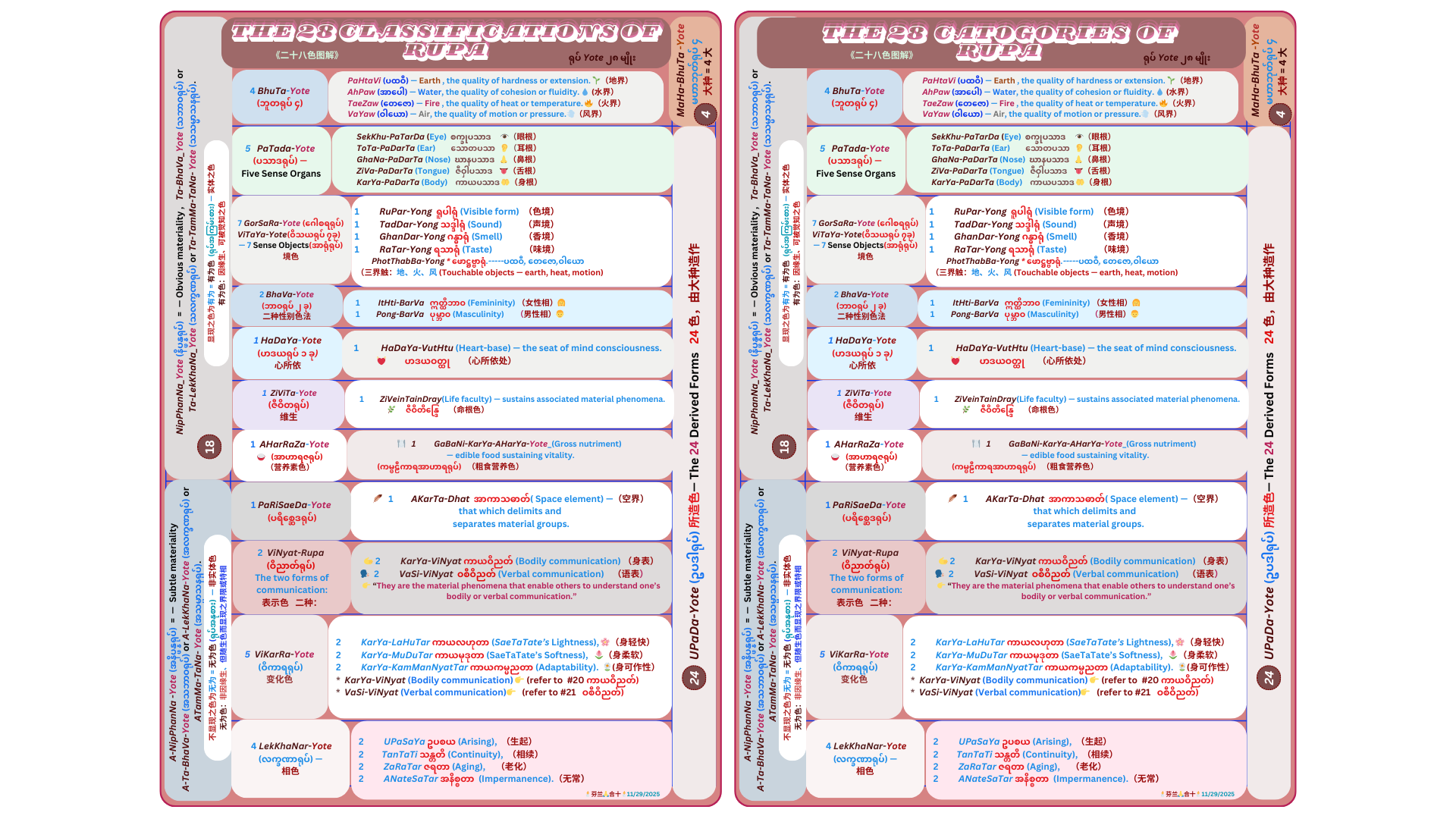
This section provides a detailed breakdown of the 28 types of material phenomena, divided into the 4 Great Essentials and 24 Derived Forms.

  1. 4 Great Essentials (BhuTa-Yote): Earth (hardness), Water (cohesion), Fire (heat), and Air (motion).
  2. 5 Sense Organs: Eye, Ear, Nose, Tongue, and Body sensitivities.
  3. 7 Sense Objects: Visible form, sound, smell, taste, and touchable objects.
  4. Subtle Materiality: Includes femininity, masculinity, the heart-base, life faculty, and nutriment.

Introduction to the Great Mindfulness Sutra

Page 12

Page 12

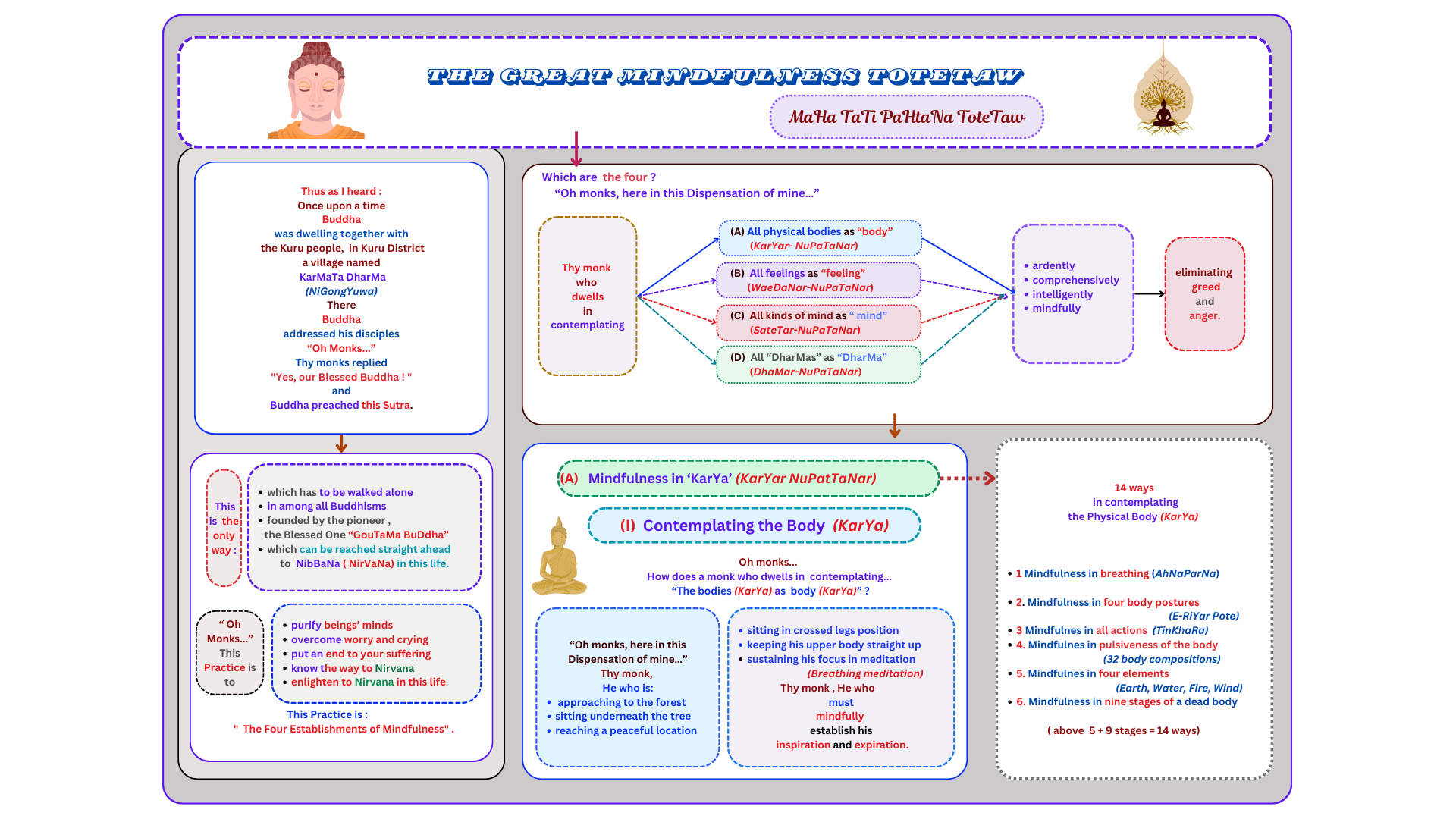
The Buddha addressed the monks in the Kuru district, declaring this practice as the "only way" for the purification of beings and the attainment of Nirvana.

  1. The Four Establishments: Body (KarYa), Feeling (WaeDaNar), Mind (SateTa), and Reality (DharMa).
  2. Body Contemplation consists of 14 ways, starting with mindfulness of breathing and posture.
  3. The practitioner must sit with a straight body and establish focus to eliminate greed and anger.

Mindfulness of Breathing (AhNarParNa)

Page 13

Page 13

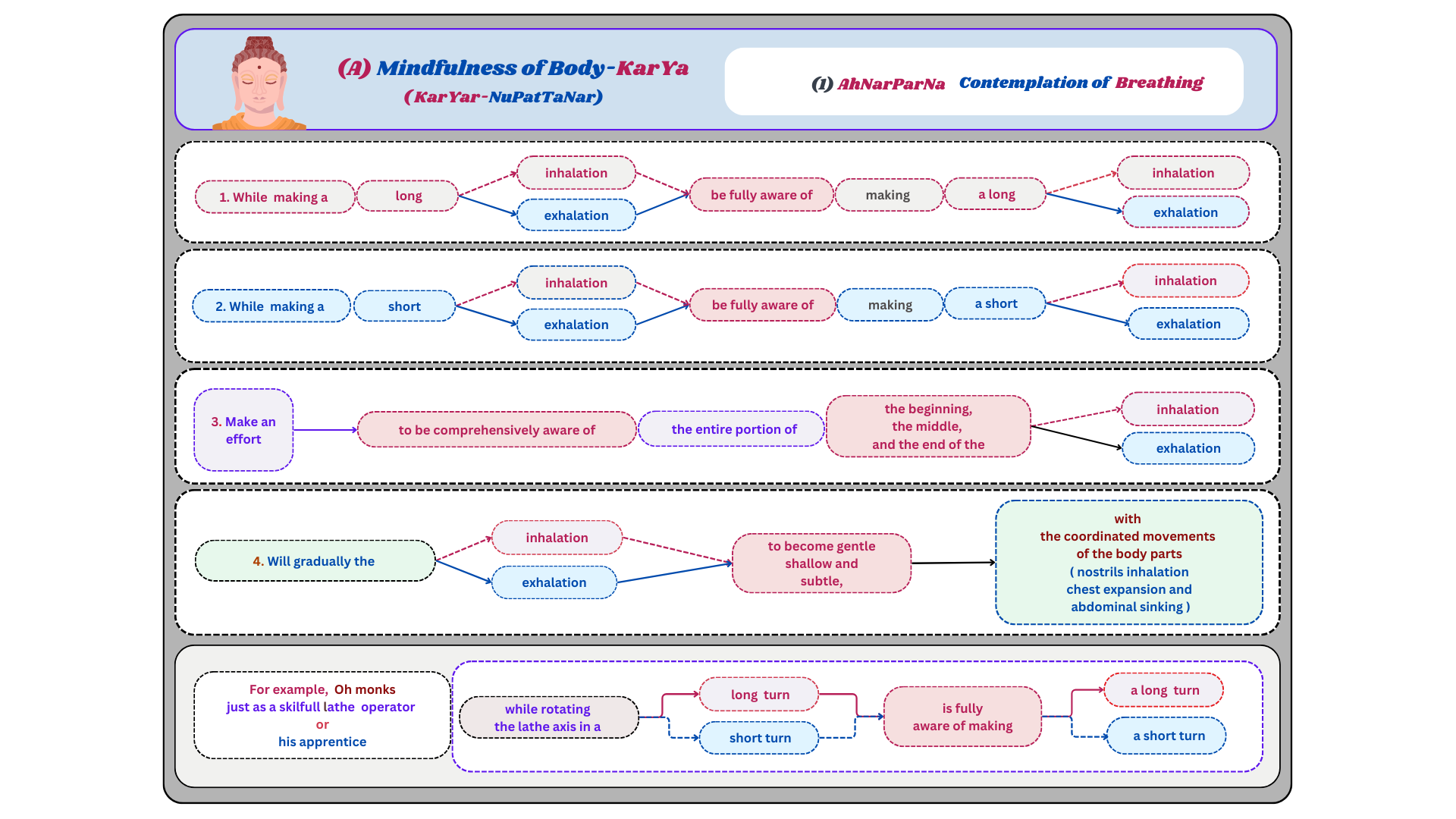
The practice of breathing meditation involves being fully aware of the duration and nature of each inhalation and exhalation.

  1. Awareness of long inhalations and exhalations.
  2. Awareness of short inhalations and exhalations.
  3. Training to be aware of the entire portion (beginning, middle, and end) of the breath.
  4. Gradually calming the breath to become gentle, shallow, and subtle.

Contemplation of the Wind Body

Page 14

Page 14

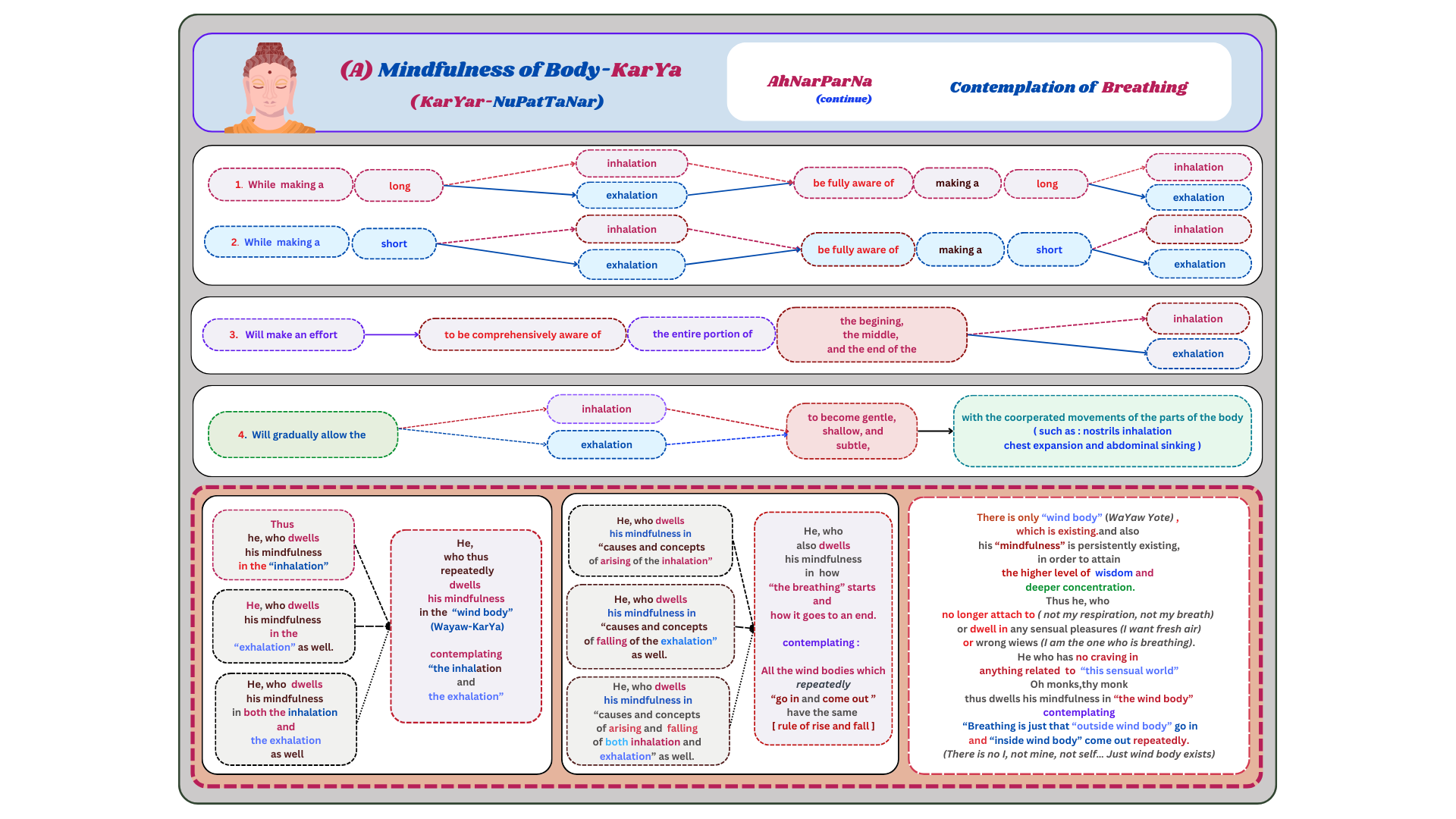
The practitioner realizes that breathing is merely the "wind body" (WaYaw Yote) moving in and out, devoid of a permanent self or "I."

  1. Observing the causes and conditions of the rising and falling of breath.
  2. Developing detachment from the breath (not "my" respiration).
  3. Persistently maintaining mindfulness to attain higher wisdom and deeper concentration.

Mindfulness of Postures and Actions

Page 15

Page 15

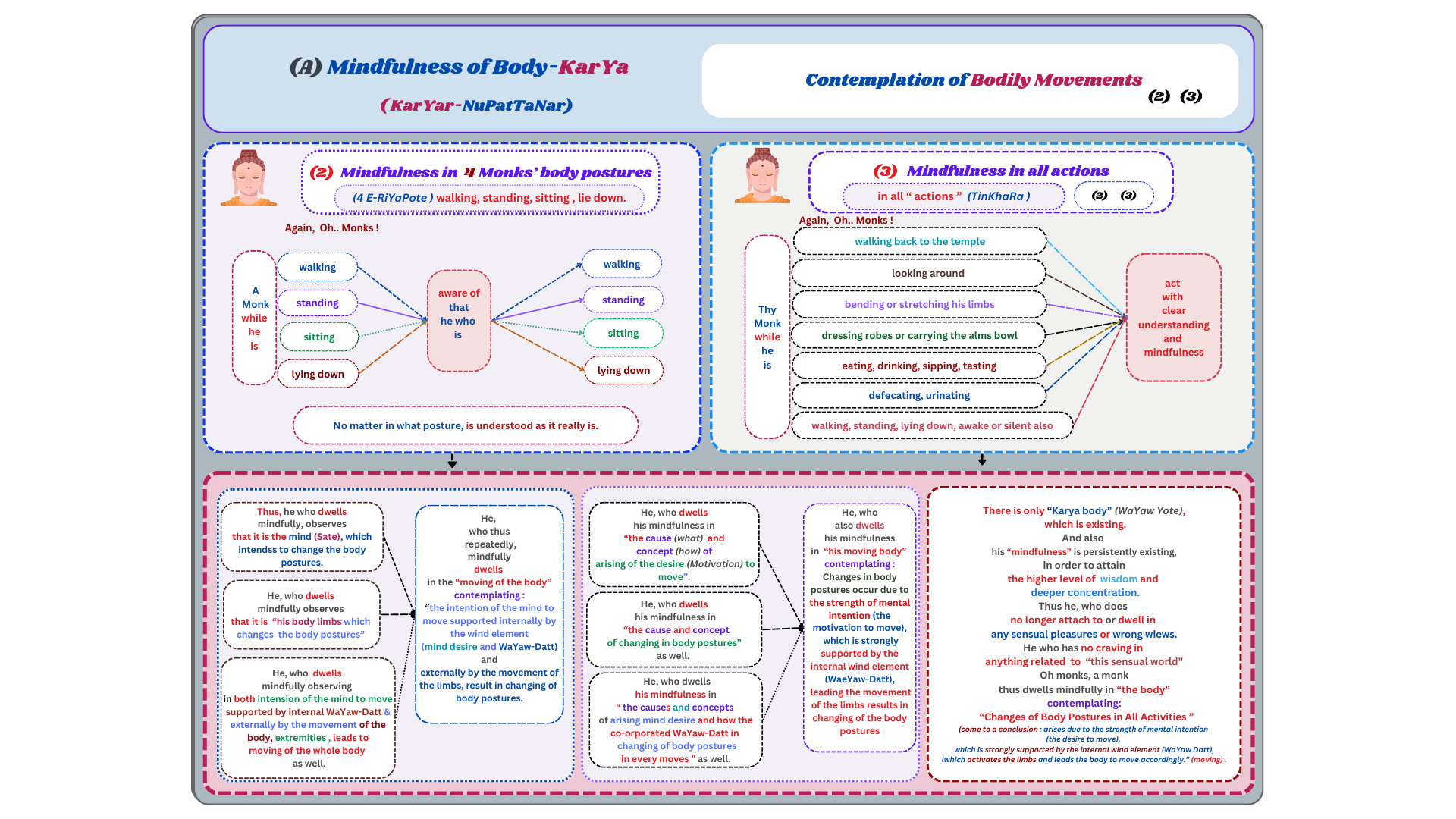
This section covers mindfulness in the four main postures (walking, standing, sitting, lying down) and all daily activities (TinKhaRa).

  1. Understanding that bodily movements arise from the mind's intention supported by the wind element (WaYaw Datt).
  2. Maintaining clear understanding during actions like dressing, eating, drinking, and even defecating.
  3. Observing how the "moving body" is a result of mental motivation and physical elements working together.

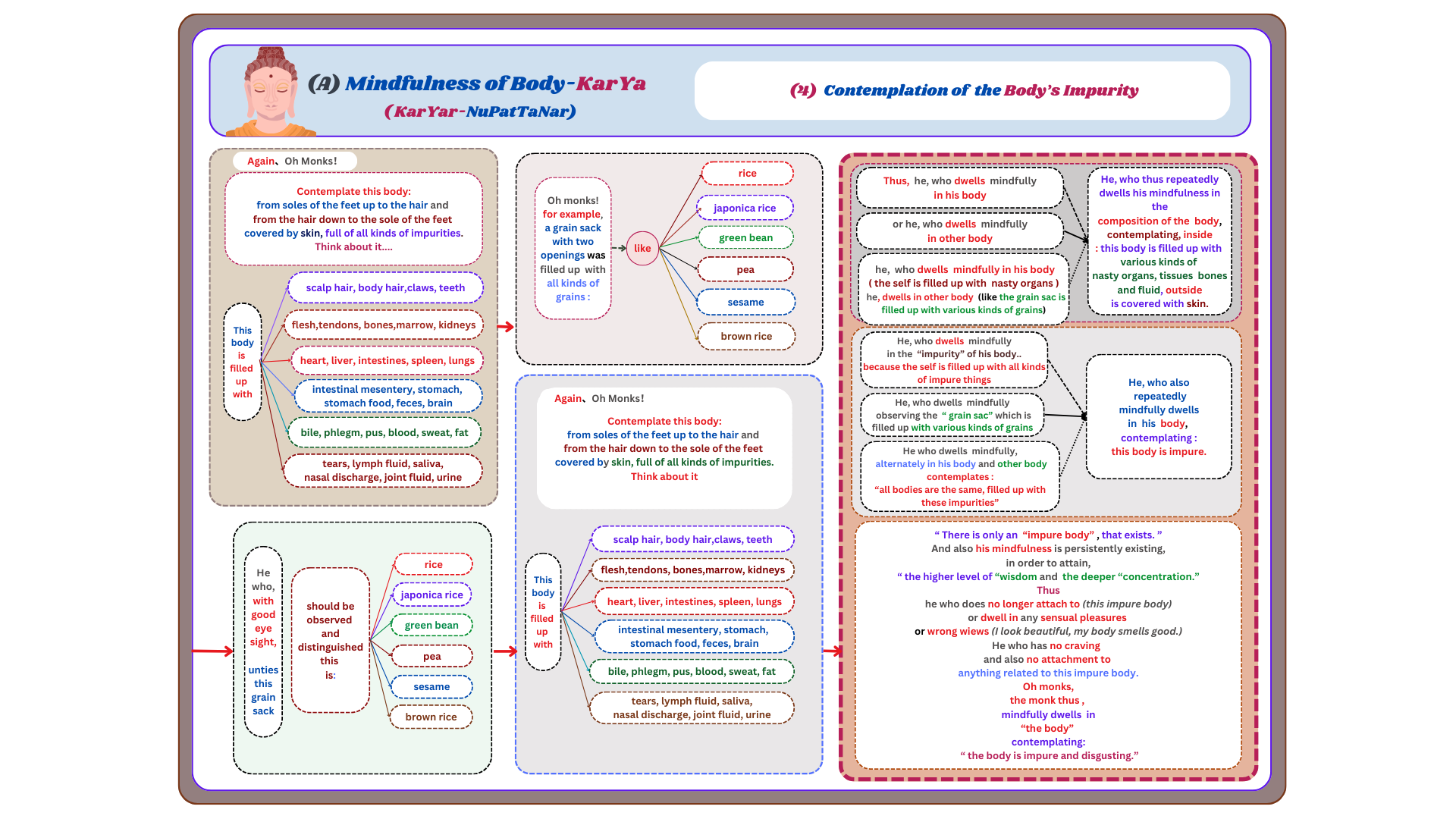
Contemplation of the Body’s Impurity

Page 16

Page 16

Using the metaphor of a grain sack, the Buddha explains how to contemplate the body as a collection of various impure parts.

  1. Scanning from the soles of the feet to the hair, identifying 32 body parts including flesh, tendons, bones, and fluids.
  2. Realizing the body is "impure and disgusting" to break the attachment to beauty and the self.
  3. Reflecting that all bodies, one's own and others', are composed of these same impurities.

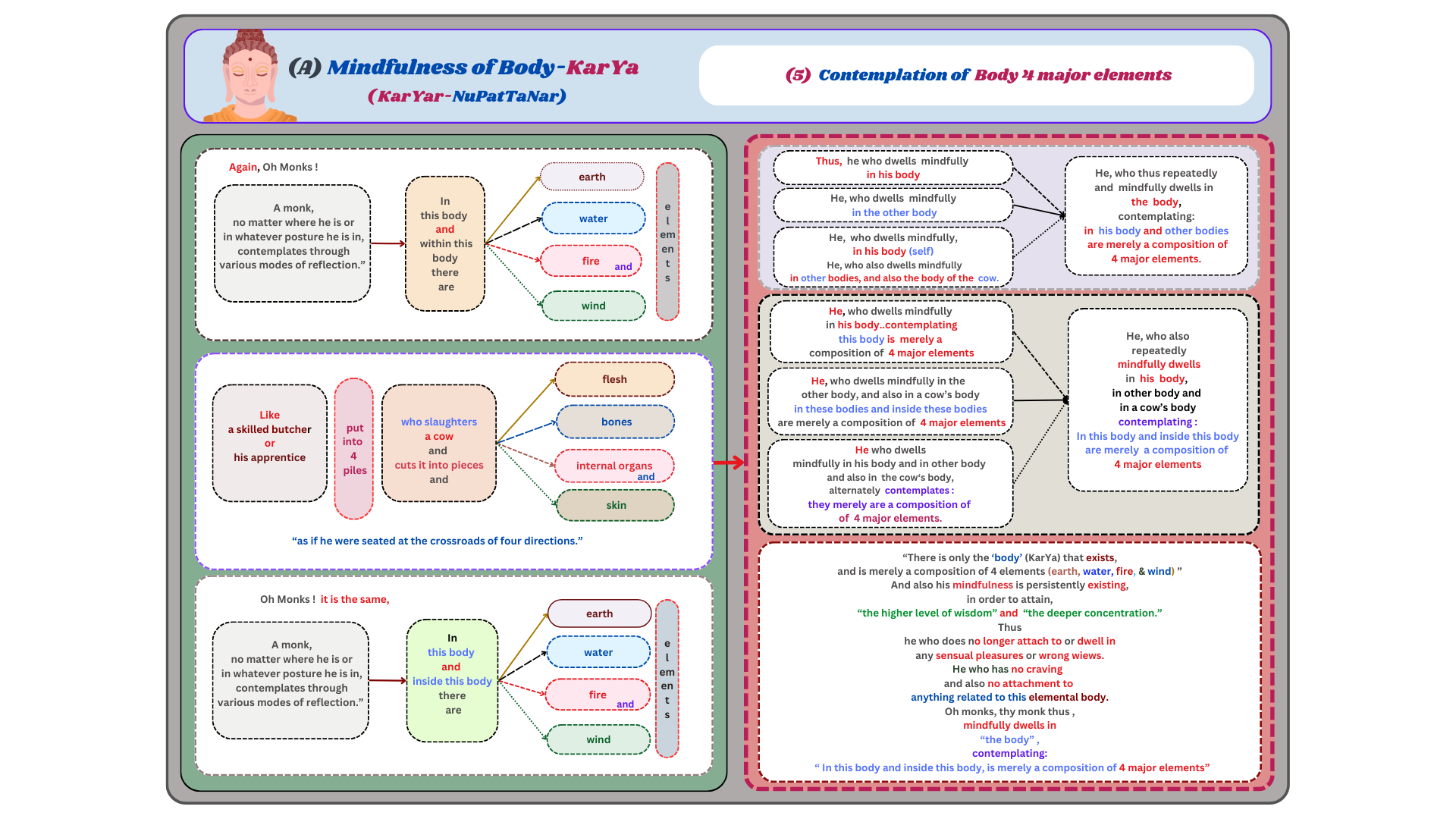
Contemplation of the Four Major Elements

Page 17

Page 17

Similar to a butcher cutting a cow into piles, the monk reflects on the body as being merely a composition of the four elements.

  1. Earth, Water, Fire, and Wind: Identifying these qualities within the physical frame.
  2. Recognizing that there is only the "elemental body" and no "person" or "being" within.
  3. Using this reflection to eliminate wrong views and sensual attachments to the body.

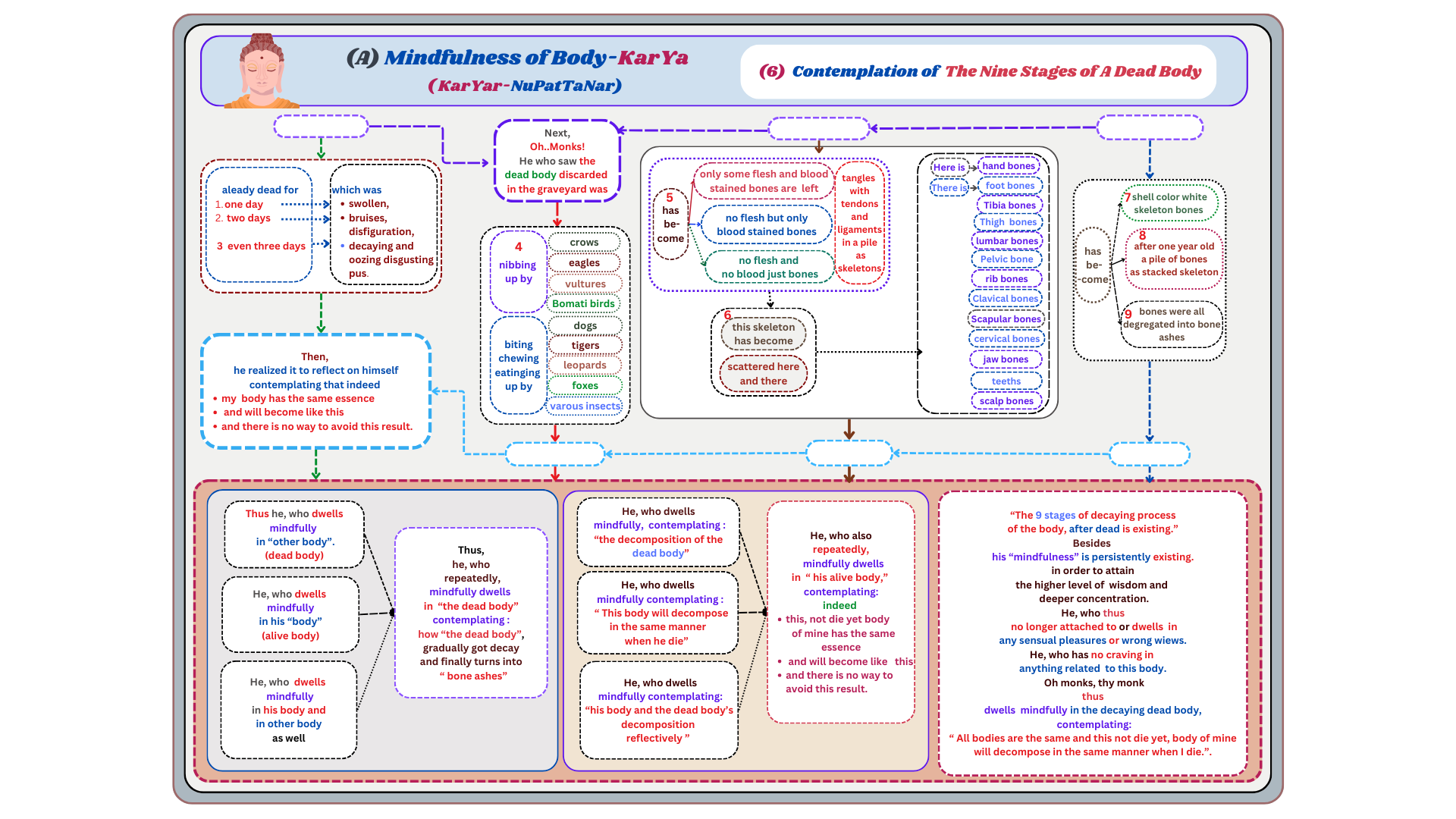
The Nine Stages of a Decaying Dead Body

Page 18

Page 18

The practitioner observes the stages of decomposition of a corpse in a graveyard to reflect on the nature of their own alive body.

  1. Stages range from a swollen, blue corpse to scattered bones and finally bone ashes.
  2. Reflecting: "My body has the same essence and will become like this; there is no way to avoid it."
  3. This practice destroys craving and attachment to the physical form through the realization of inevitable decay.

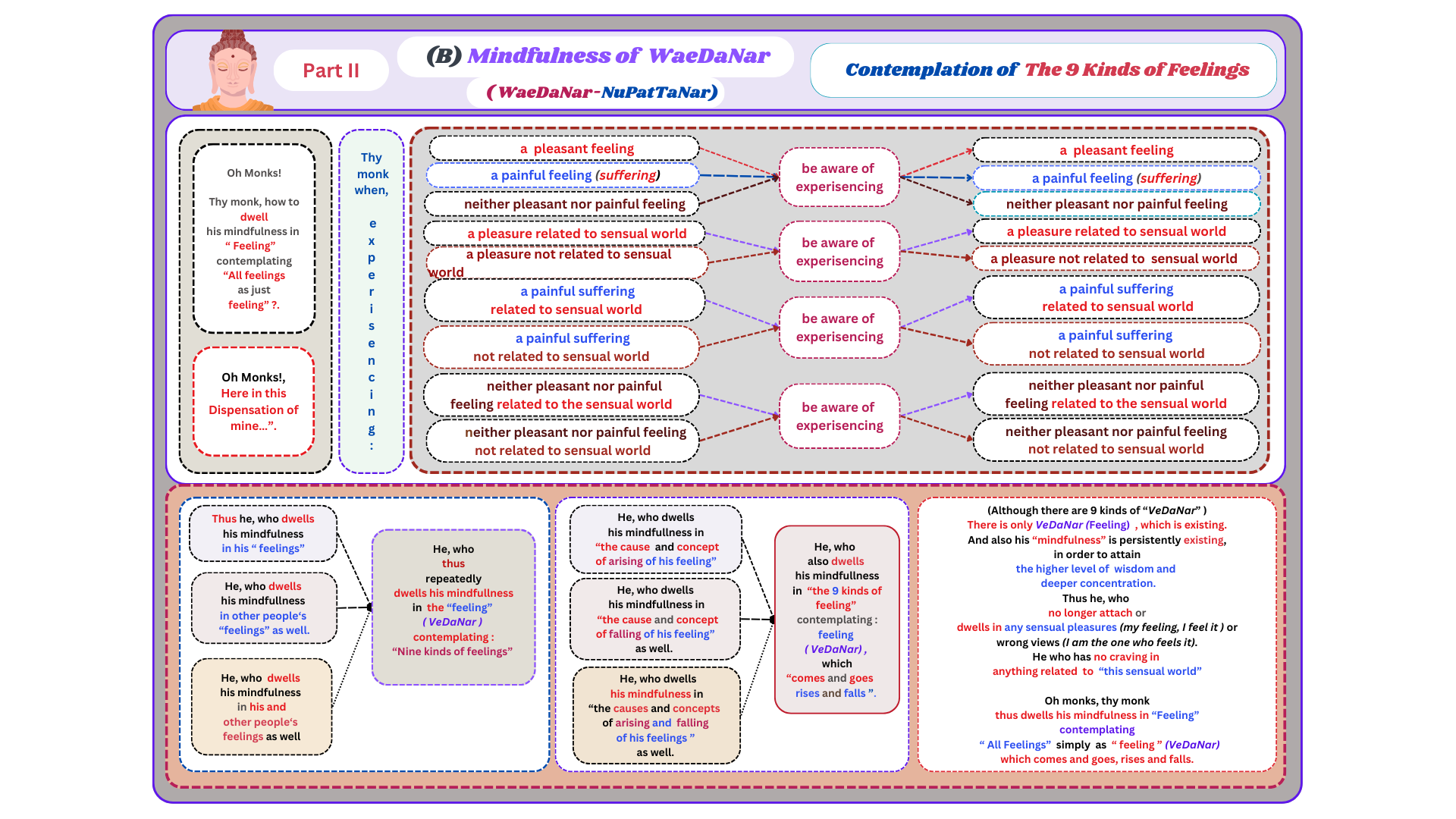
Contemplation of the 9 Kinds of Feelings (WaeDaNar)

Page 19

Page 19

Mindfulness of feeling involves identifying the specific nature of sensations as they arise and pass away.

  1. Recognizing pleasant, painful, and neutral feelings.
  2. Distinguishing between feelings related to the sensual world and those not related to the sensual world (spiritual feelings).
  3. Understanding that feeling is just "feeling"—it comes and goes, rises and falls, without an "I" who feels it.

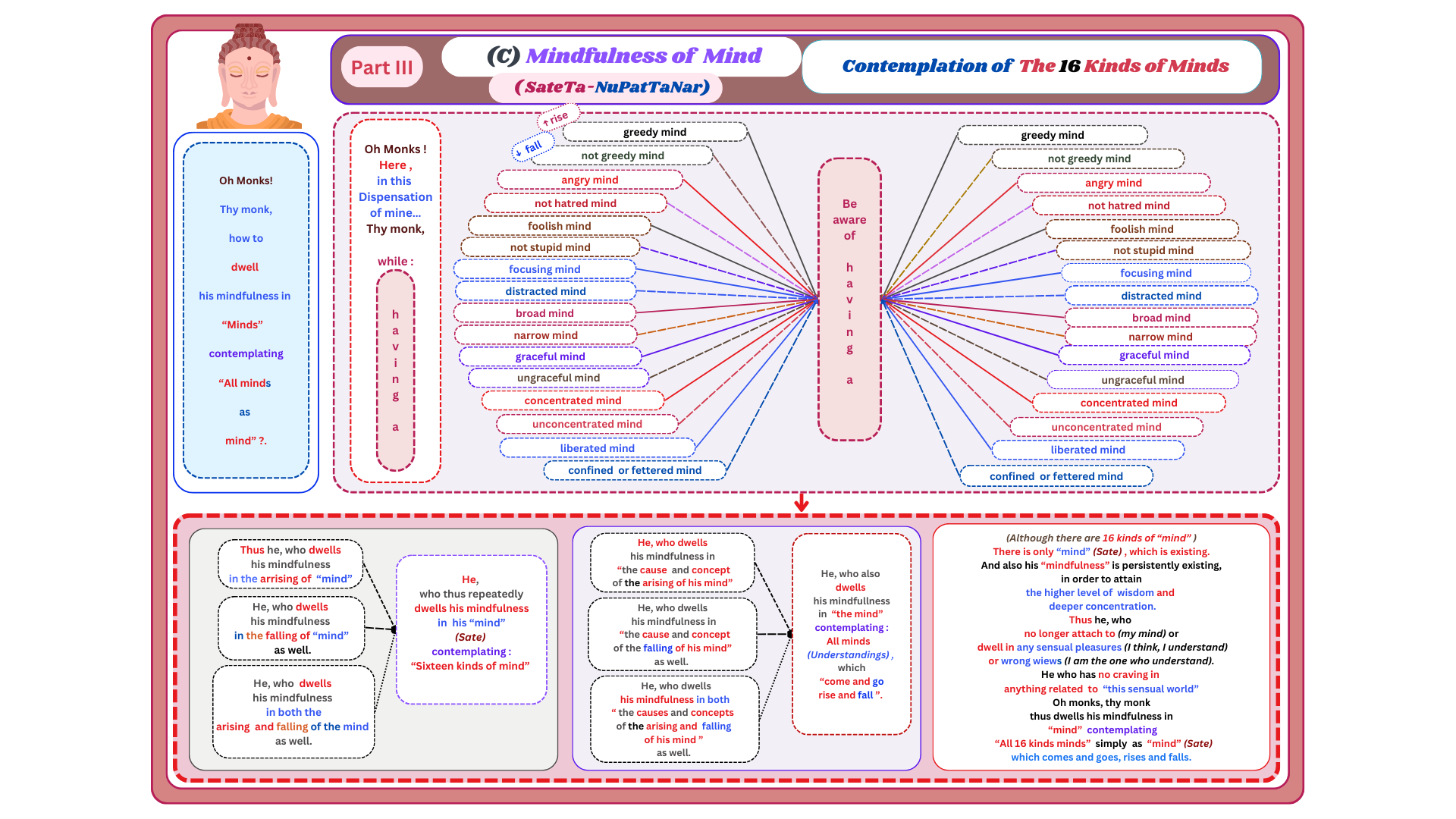
Contemplation of the 16 Kinds of Minds (SateTa)

Page 20

Page 20

This section explains how to be aware of the state of the mind as it arises and falls, identifying 16 distinct mental states.

  1. Differentiating between states such as greedy/not greedy, angry/not angry, distracted/focused, and liberated/fettered.
  2. Realizing that there is only the "mind" (Sate) existing as a natural process, not a permanent self or "I."
  3. Observing the causes and concepts behind the arising and falling of these mental states to attain deeper concentration.

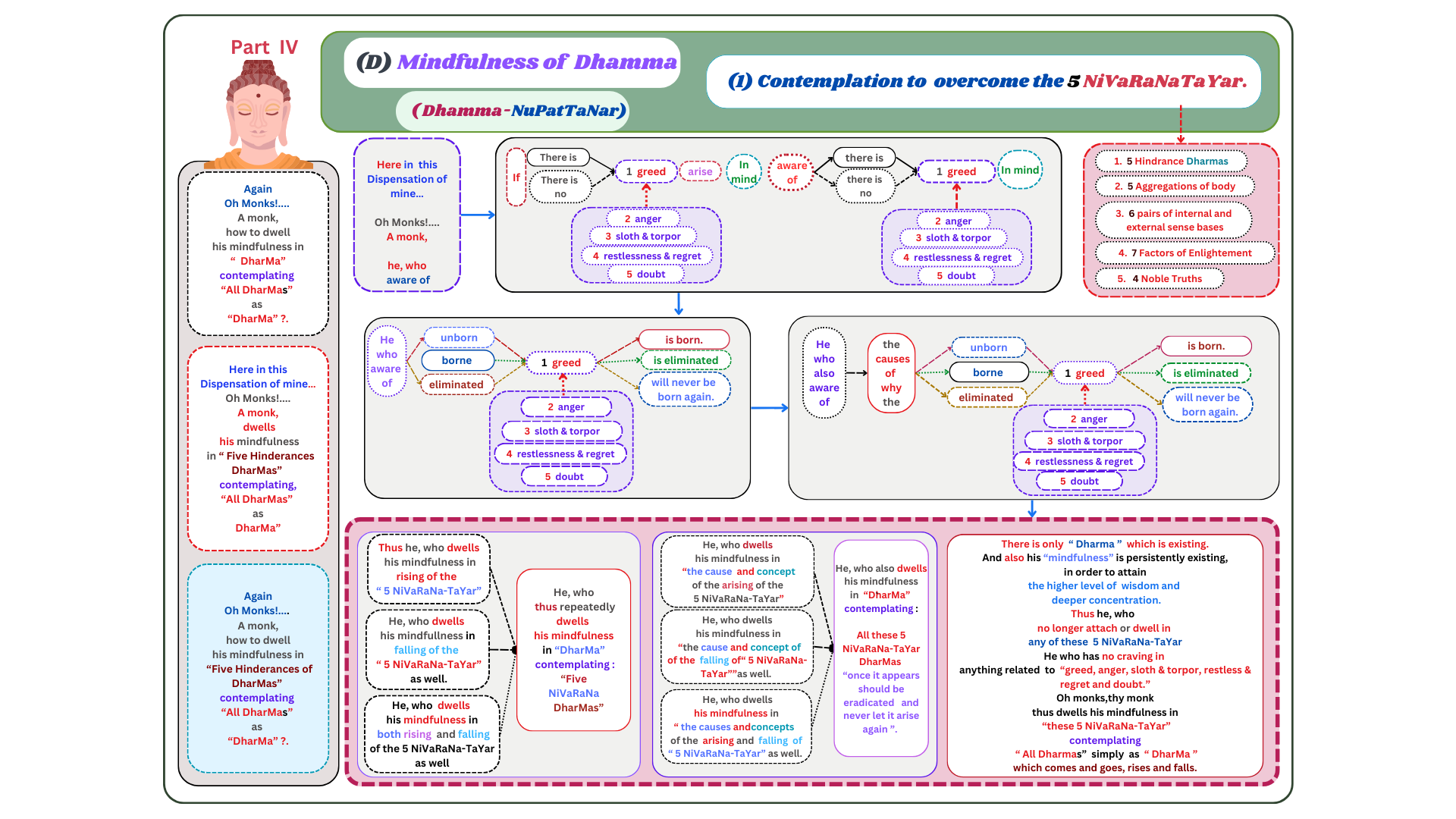
Contemplation of the 5 Hindrances (NiVaRaNa)

Page 21

Page 21

Mindfulness in Dhamma begins with identifying and overcoming the five mental obstacles that hinder progress.

  1. The 5 Hindrances: Greed, Anger, Sloth & Torpor, Restlessness & Regret, and Doubt.
  2. The practitioner notes when a hindrance is present, when it is absent, how it arises, and how it is eliminated.
  3. The goal is to ensure that once a hindrance is eradicated, it never arises again.

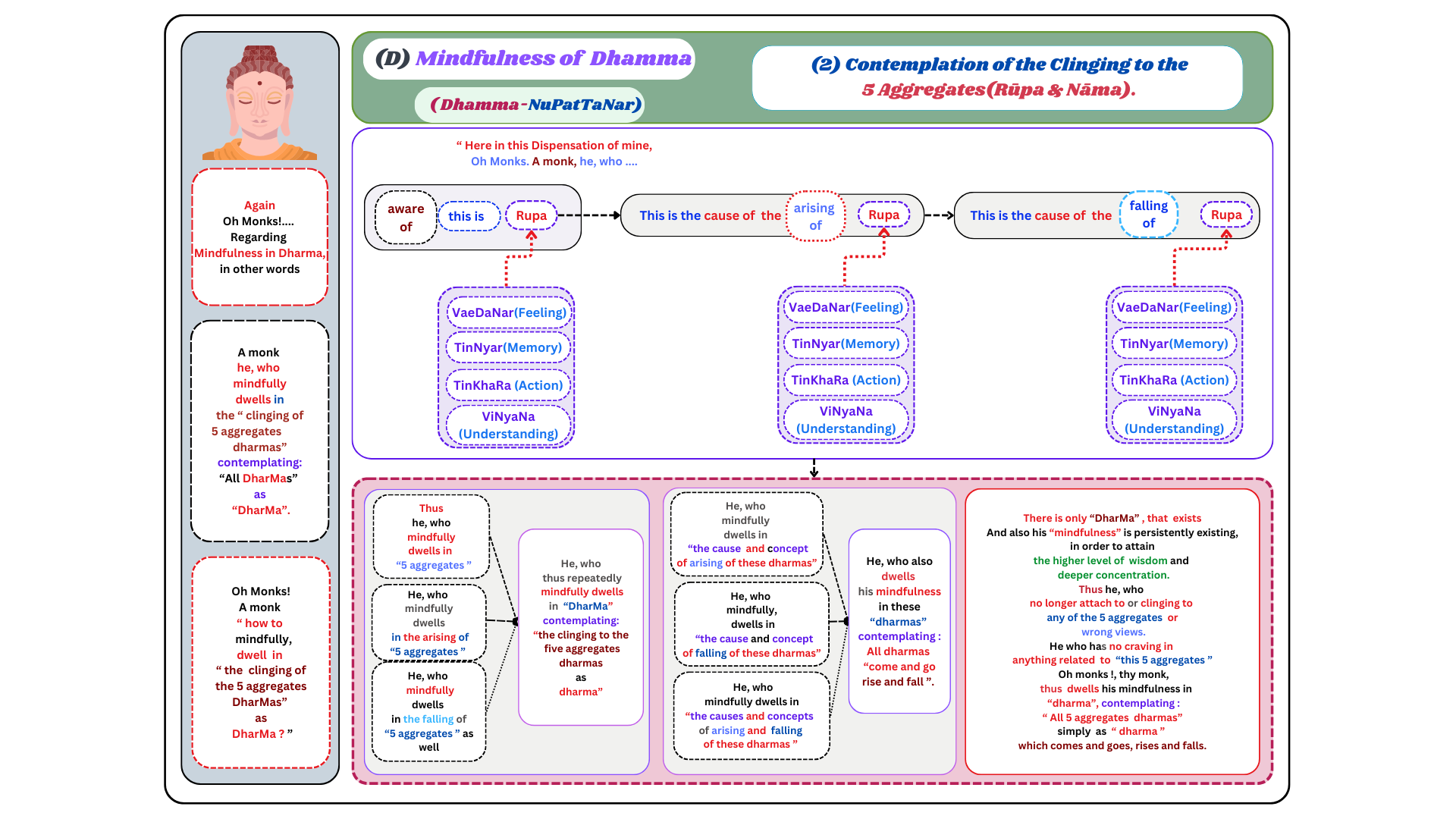
Contemplation of the 5 Aggregates (KhanDas)

Page 22

Page 22

The monk contemplates the nature of existence through the five aggregates, understanding how we cling to them.

  1. The 5 Aggregates: Form (Rupa), Feeling (VaeDaNar), Memory/Perception (TinNyar), Mental Formations (TinKhaRa), and Consciousness (ViNyaNa).
  2. Observing the specific causes for the arising and falling of each aggregate.
  3. Developing detachment by realizing these are merely "Dhamma" processes that rise and fall, rather than a "self."

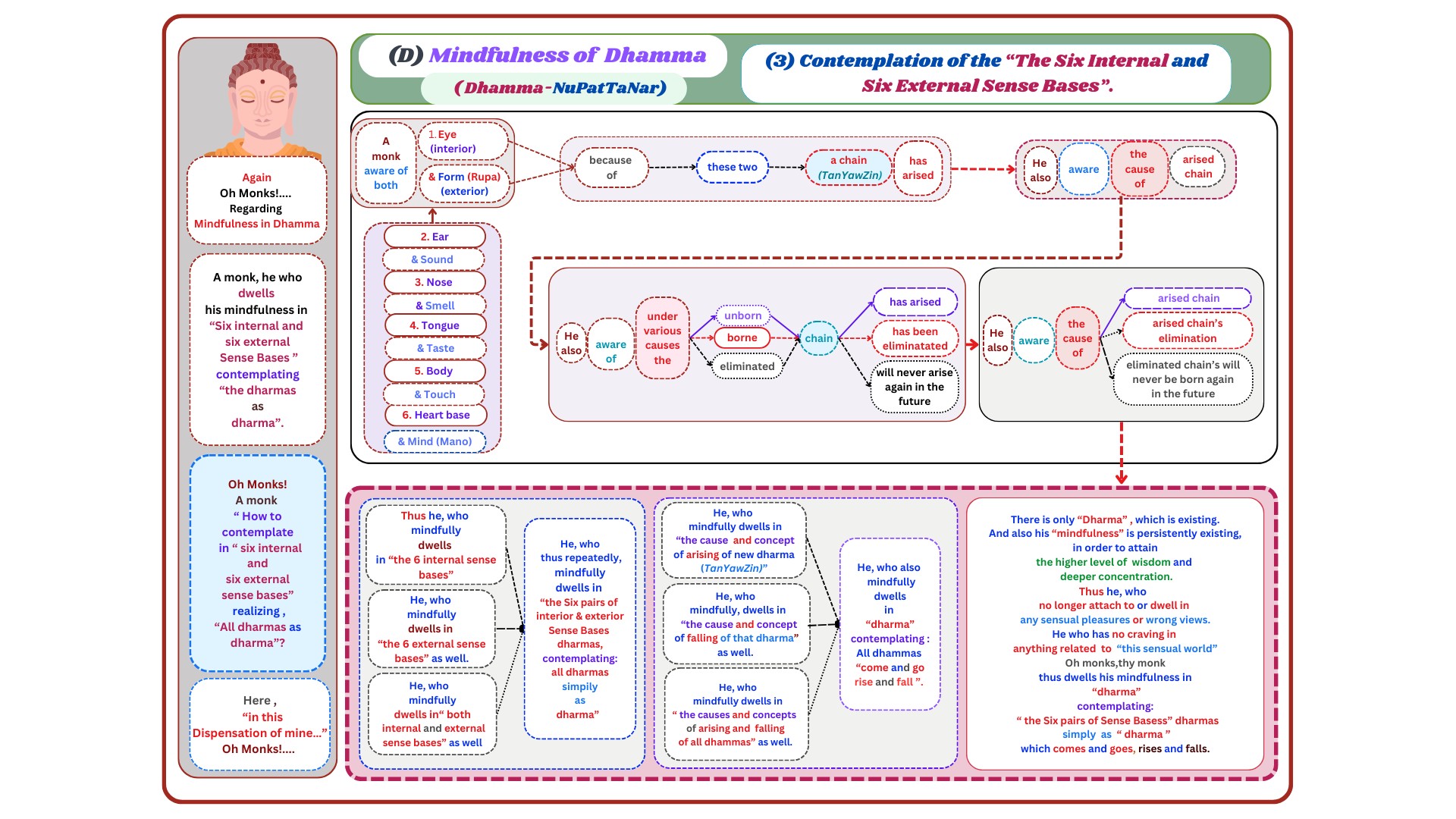
The 6 Internal and 6 External Sense Bases

Page 23

Page 23

This section explores the relationship between the internal sense organs and external objects, and the "chain" (fetter) that arises from them.

  1. The 6 Pairs: Eye/Form, Ear/Sound, Nose/Smell, Tongue/Taste, Body/Touch, and Mind/Ideas.
  2. Understanding how a "chain" of attachment (TanYawZin) arises when a sense organ meets an object.
  3. Mindfully observing how these fetters arise, how they are eliminated, and how to prevent them from arising in the future.

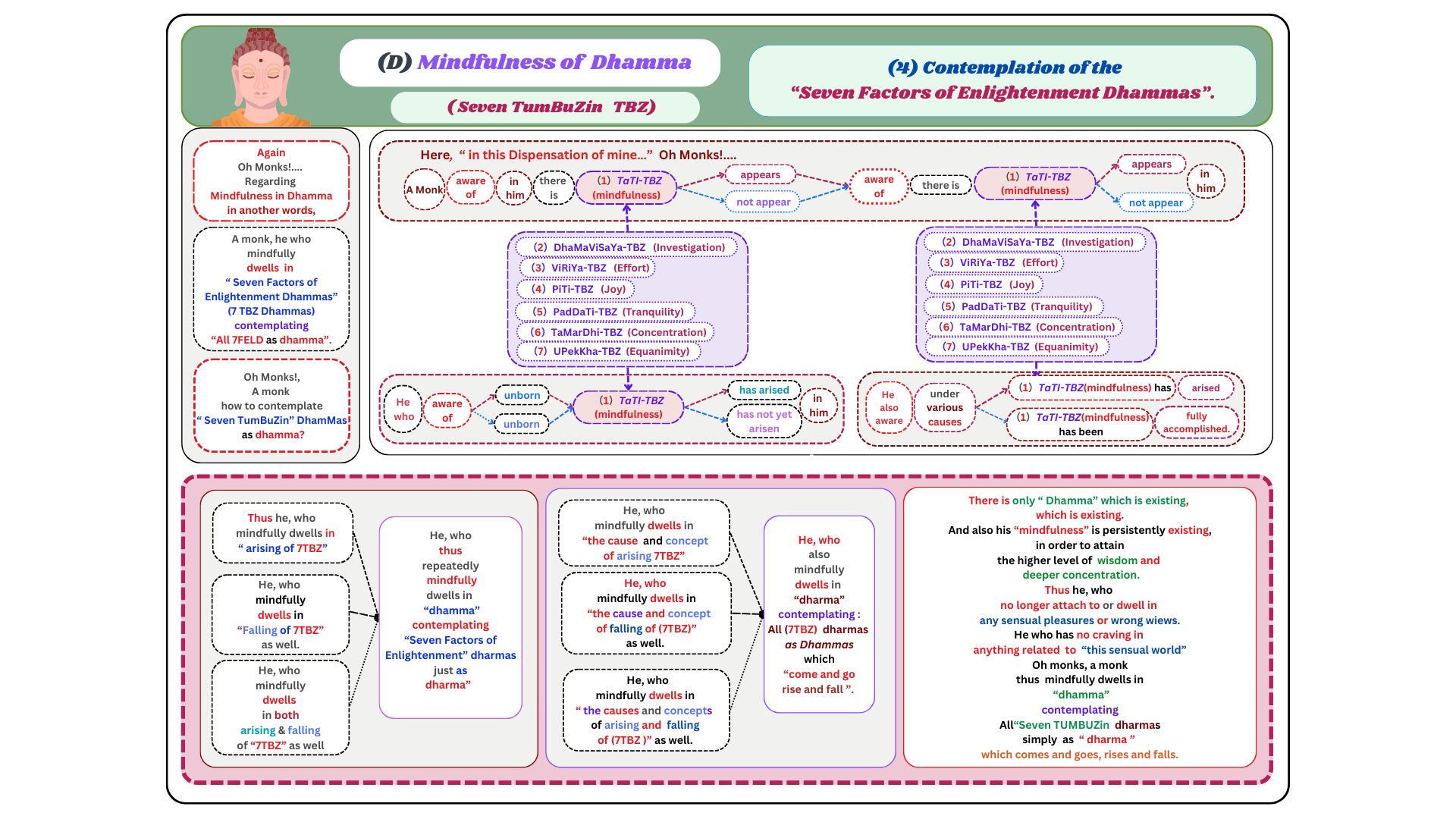
The 7 Factors of Enlightenment (TumBuZin)

Page 24

Page 24

The monk observes the presence or absence of the qualities that lead to enlightenment within his own mind.

  1. The 7 Factors: Mindfulness, Investigation, Effort, Joy, Tranquility, Concentration, and Equanimity.
  2. Awareness of whether a factor has arisen, how it arose, and when it has been fully accomplished.
  3. Recognizing these factors as "Dhamma" that leads to the higher level of wisdom.

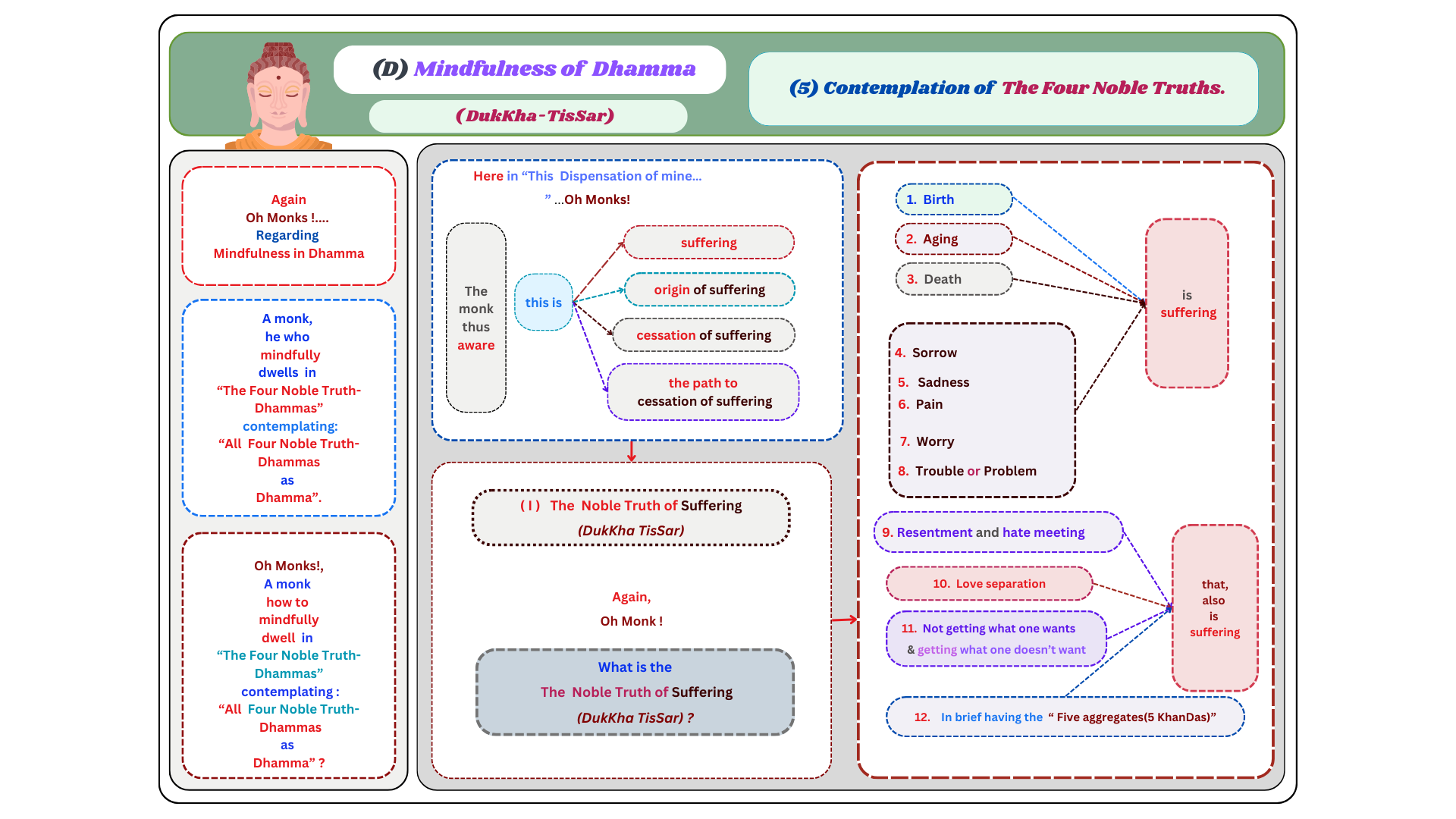
The Four Noble Truths (TisSar)

Page 25

Page 25

The core of the Dhamma contemplation is the realization of the Four Noble Truths: Suffering, its Origin, its Cessation, and the Path.

  1. The Truth of Suffering (DukKha): Identifying 12 specific forms of suffering, from birth to the five aggregates.
  2. Mindfully dwelling in these truths to understand the reality of existence.
  3. The practitioner sees all these truths as "Dhamma," helping to remove craving and attachment to the world.

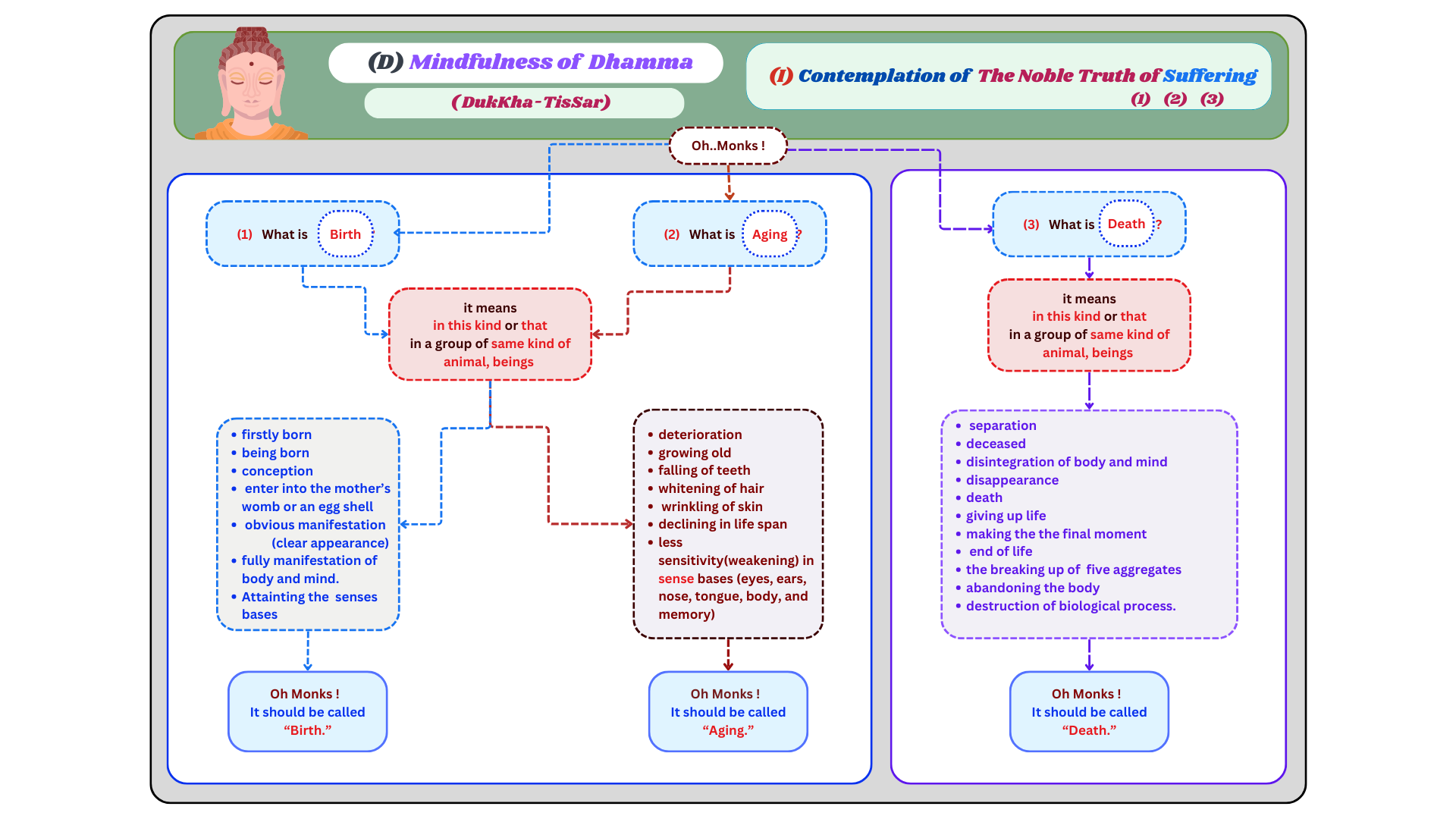
Definitions of Birth, Aging, and Death

Page 26

Page 26

Detailed definitions of the first three aspects of the Noble Truth of Suffering.

  1. Birth (ZarTi): Conception, the manifestation of aggregates, and attaining sense bases in various groups of beings.
  2. Aging (ZaRa): The whitening of hair, wrinkling of skin, and declining sensitivity of the sense bases.
  3. Death (MaRaNa): The final moment, disintegration of the aggregates, and the destruction of the biological process.

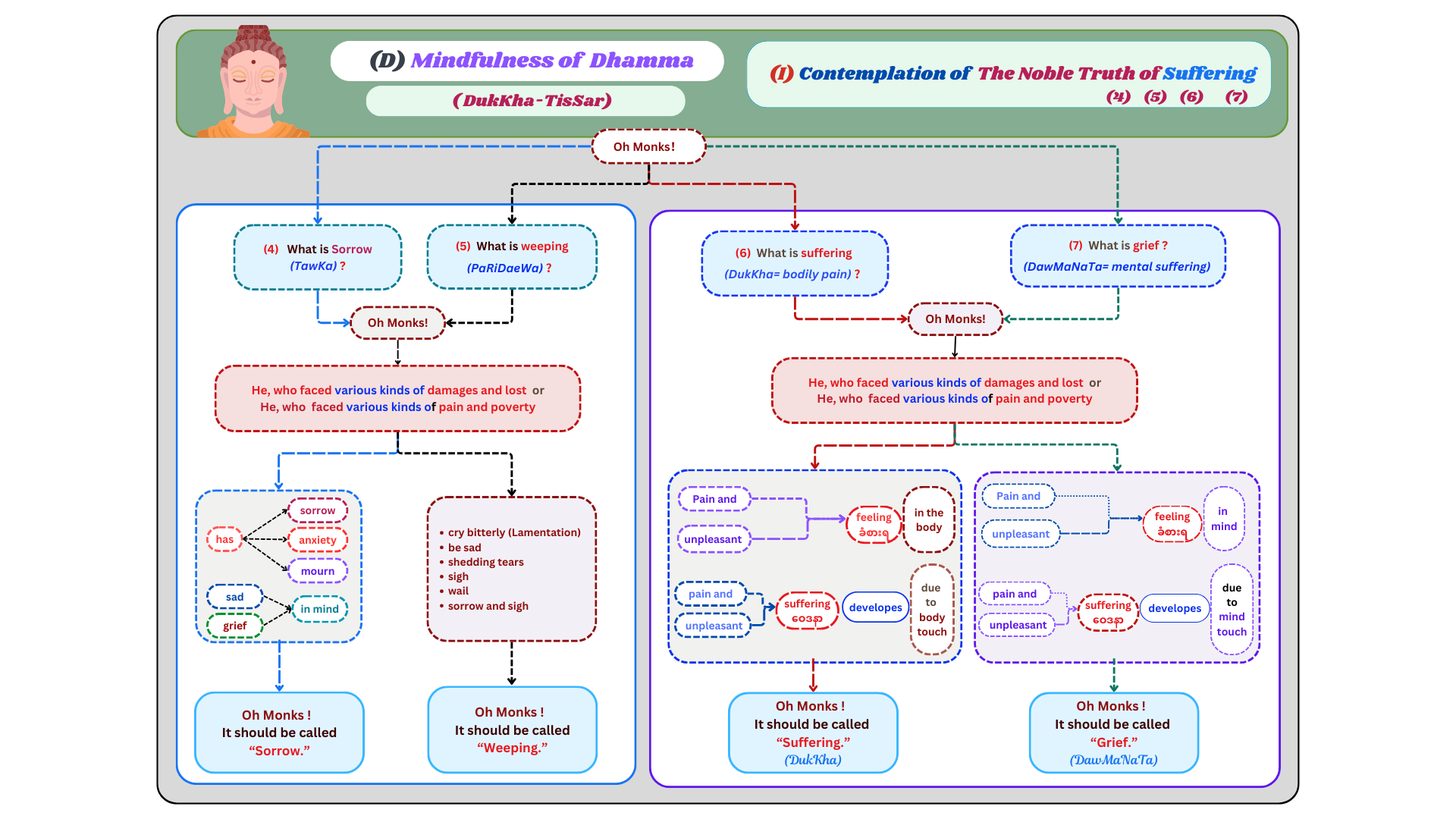
Sorrow, Lamentation, Pain, and Grief

Page 27

Page 27

Explaining the mental and physical aspects of suffering that arise from loss and poverty.

  1. Sorrow (TawKa): Inner anxiety and grief.
  2. Lamentation (PaRiDaeWa): Outward crying, wailing, and bitter tears.
  3. Physical Suffering (DukKha): Unpleasant feelings arising from bodily touch/pain.
  4. Mental Grief (DawMaNaTa): Unpleasant feelings arising from the mind's contact with suffering.

Distress and Social Sufferings

Page 28

Page 28

Defining the suffering caused by undesirable associations and the loss of loved ones.

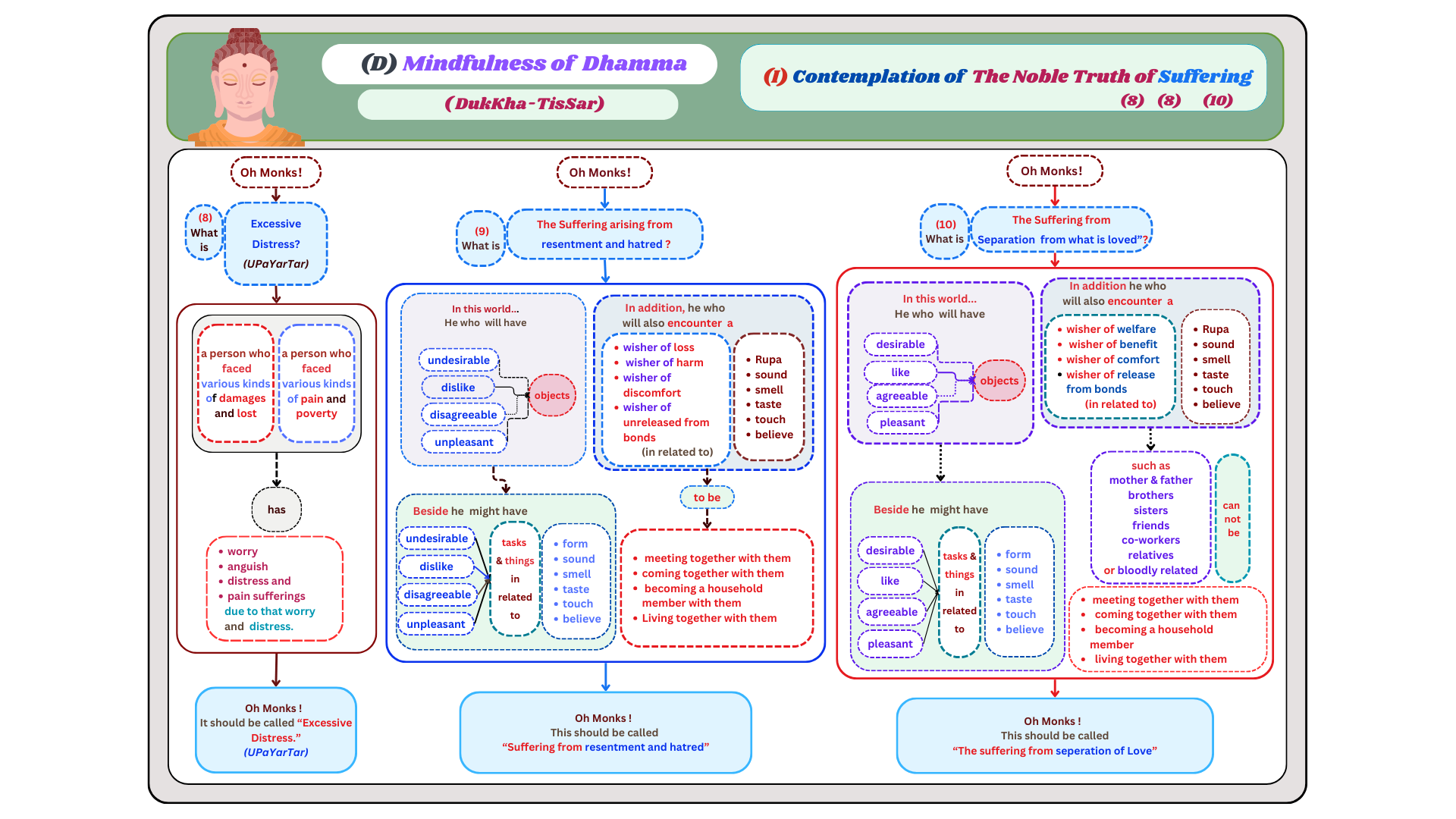
  1. Excessive Distress (UPaYarTar): Anguish and pain resulting from severe loss or poverty.
  2. Resentment and Hatred: The suffering of being forced to associate with undesirable people or objects.
  3. Separation from Love: The suffering of being unable to be with those we love (parents, friends, relatives) or pleasant objects.

Unfulfilled Desires and the 5 Aggregates

Page 29

Page 29

The final summary of the Noble Truth of Suffering, focusing on unfulfilled wishes and the nature of the aggregates.

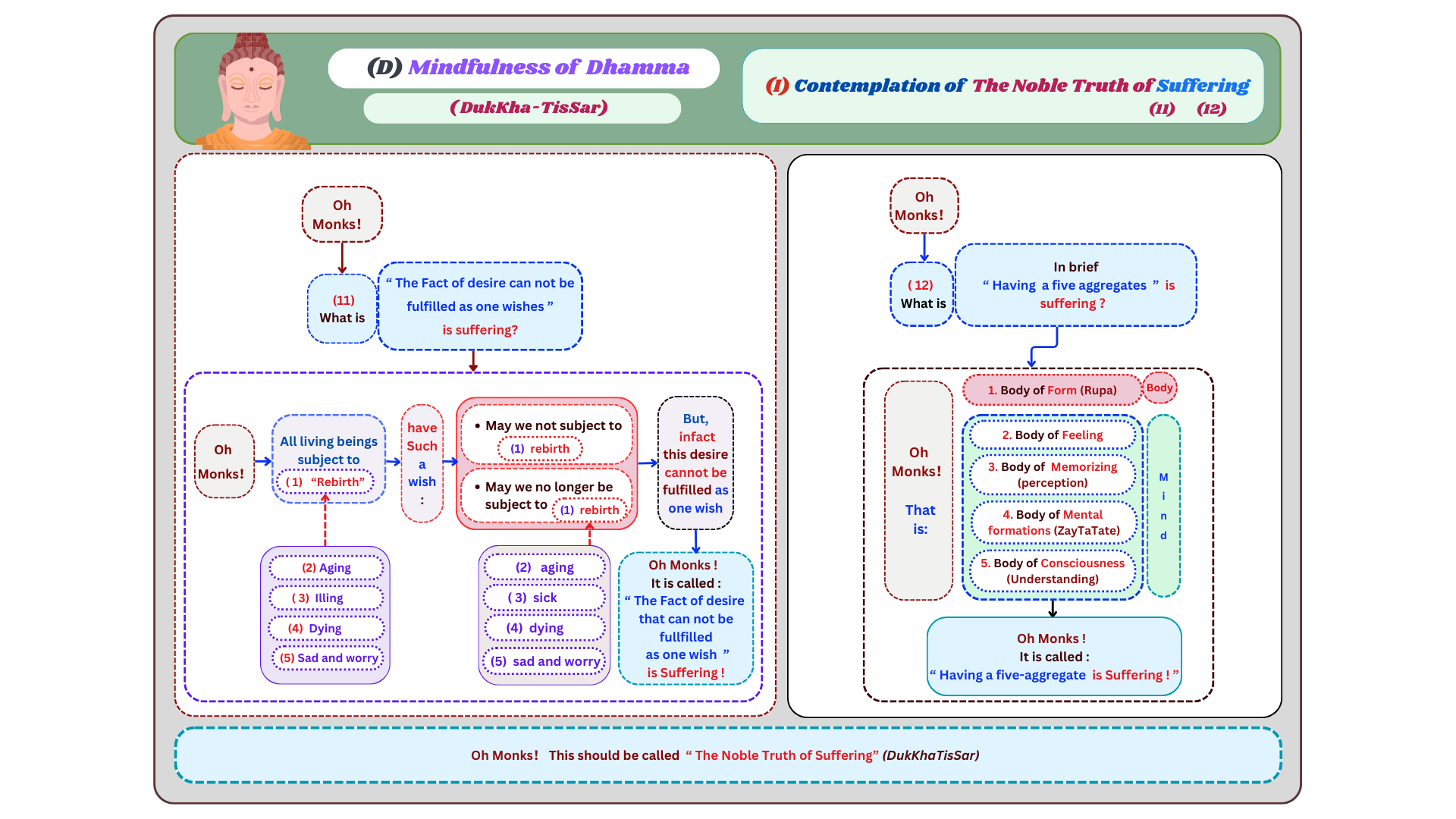
  1. The suffering of "not getting what one wants," such as the wish to avoid aging, sickness, and death.
  2. The fundamental summary: Clinging to the Five Aggregates (Form, Feeling, Perception, Formations, Consciousness) is inherently suffering.
  3. Understanding these 12 points constitutes a complete realization of the Noble Truth of Suffering.

The Noble Truth of the Origin of Suffering (Samudaya)

Page 30

Page 30

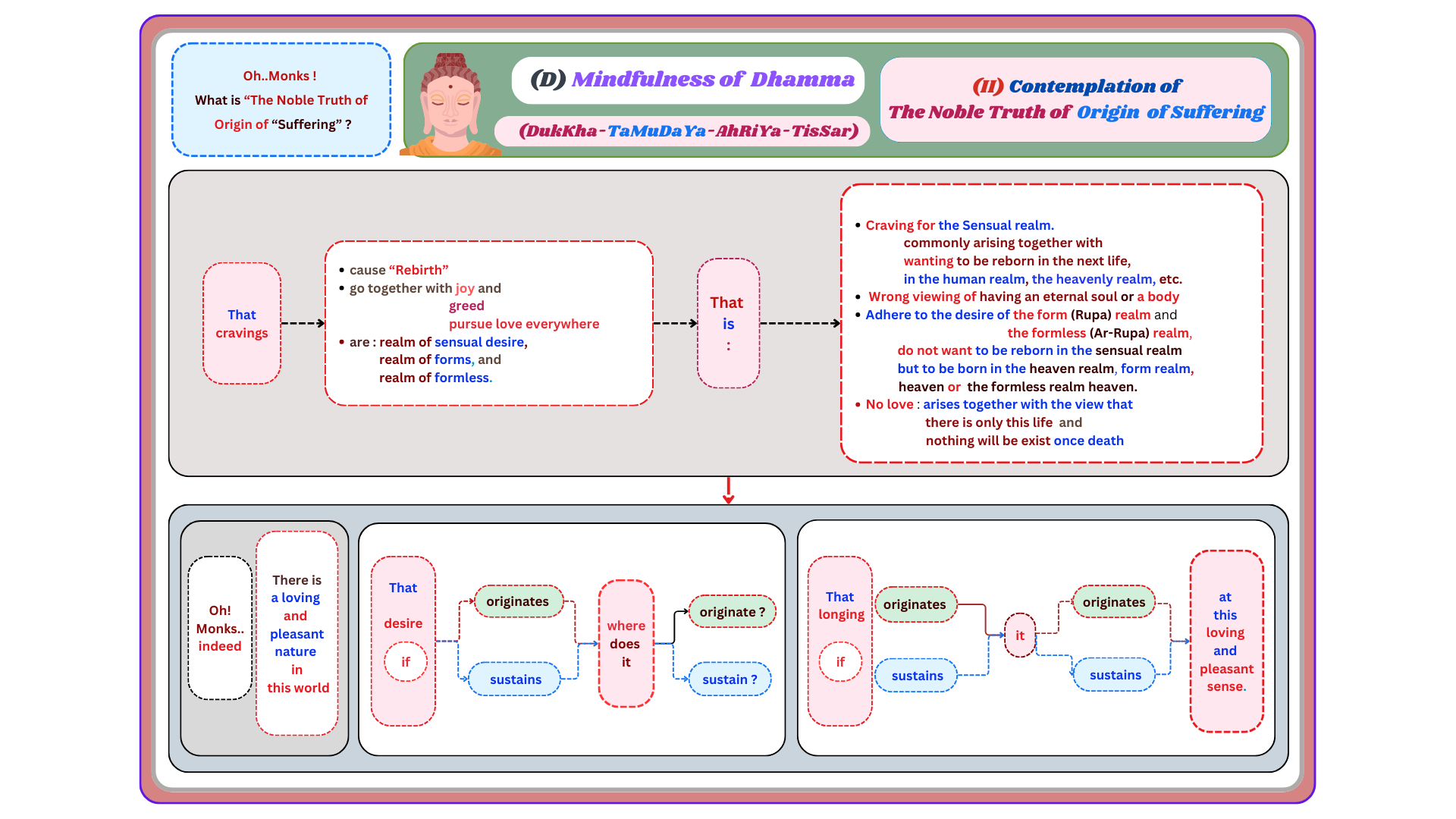
This section explores the root cause of suffering, which is identified as craving (Tanha) that leads to rebirth.

  1. Craving for Sensual Pleasure (Kama-Tanha): The desire for worldly enjoyment.
  2. Craving for Existence (Bhava-Tanha): The desire to be reborn in higher realms based on the view of an eternal soul.
  3. Craving for Non-existence (Vibhava-Tanha): The desire for annihilation, arising from the view that nothing exists after death.

Where Craving Originates and Sustains

Page 31

Page 31

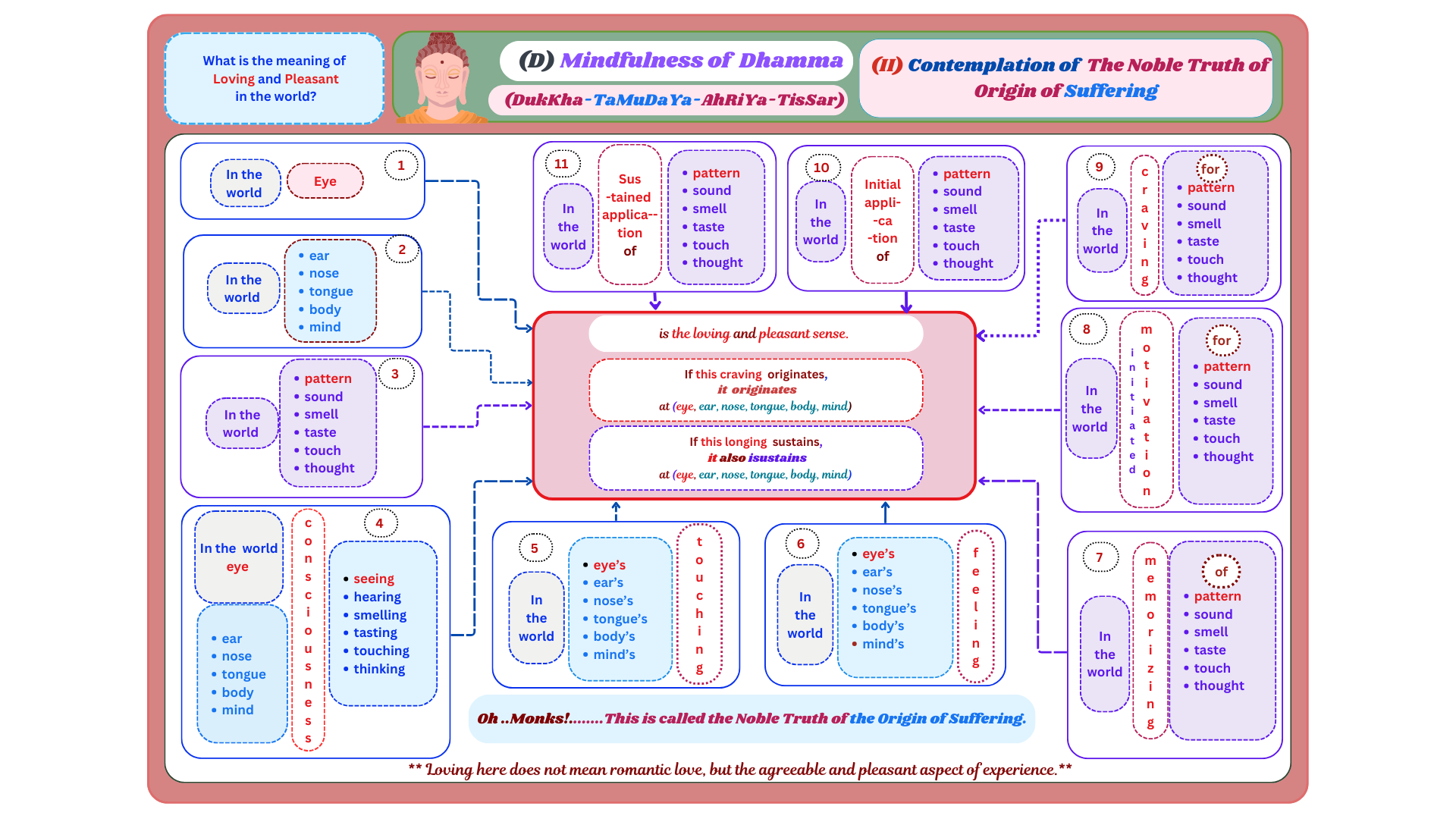
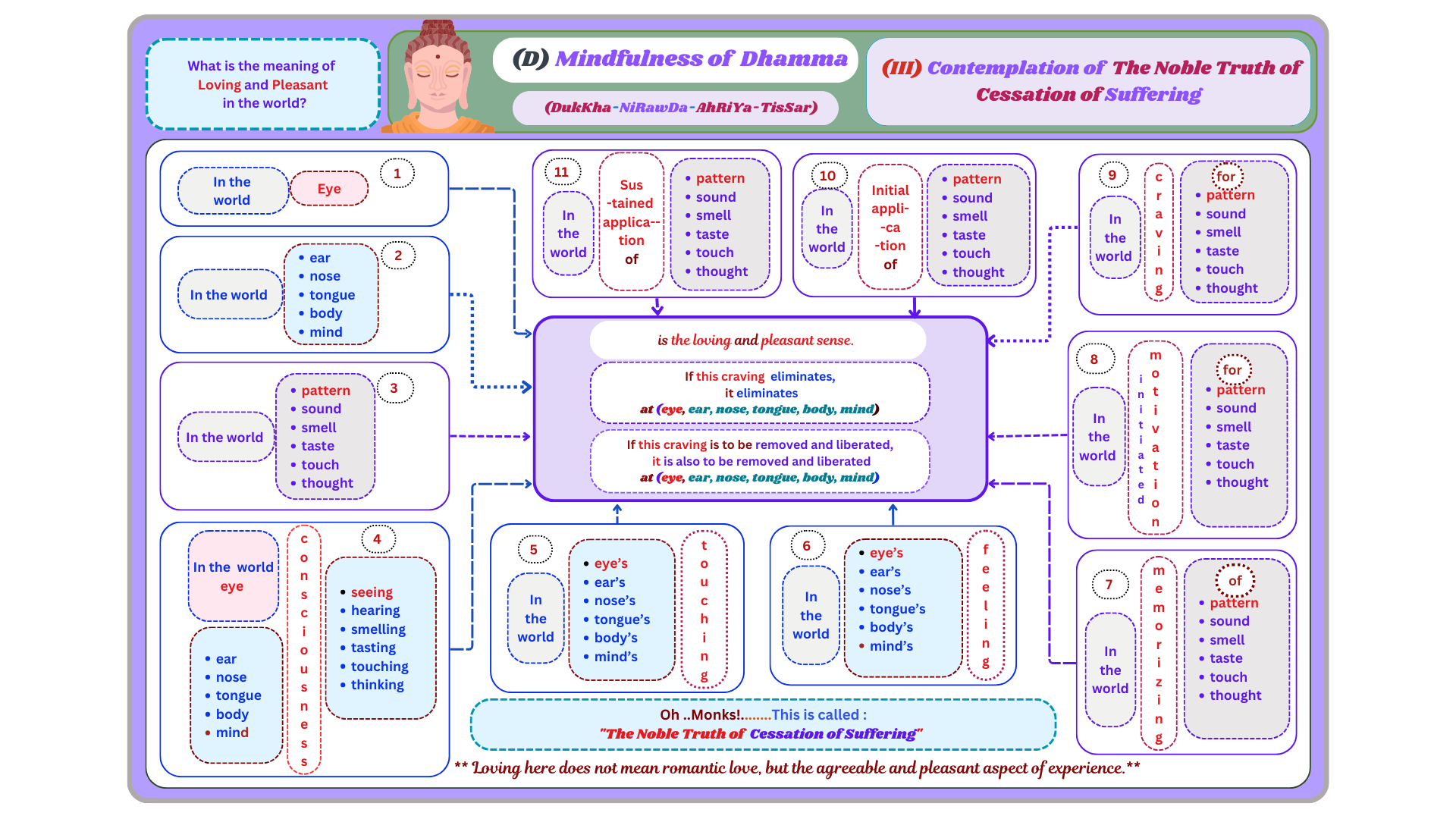
Craving does not arise in a vacuum; it originates and dwells within the "loving and pleasant" aspects of the world (agreeable experiences).

  1. The 6 Sense Bases: Craving arises at the eye, ear, nose, tongue, body, and mind.
  2. The 6 Objects and Consciousness: It attaches to patterns, sounds, smells, tastes, touches, and thoughts.
  3. The Process: It flows through seeing, hearing, thinking, and the "initial and sustained application" of the mind toward these objects.

The Noble Truth of the Cessation of Suffering (Nirodha)

Page 32

Page 32

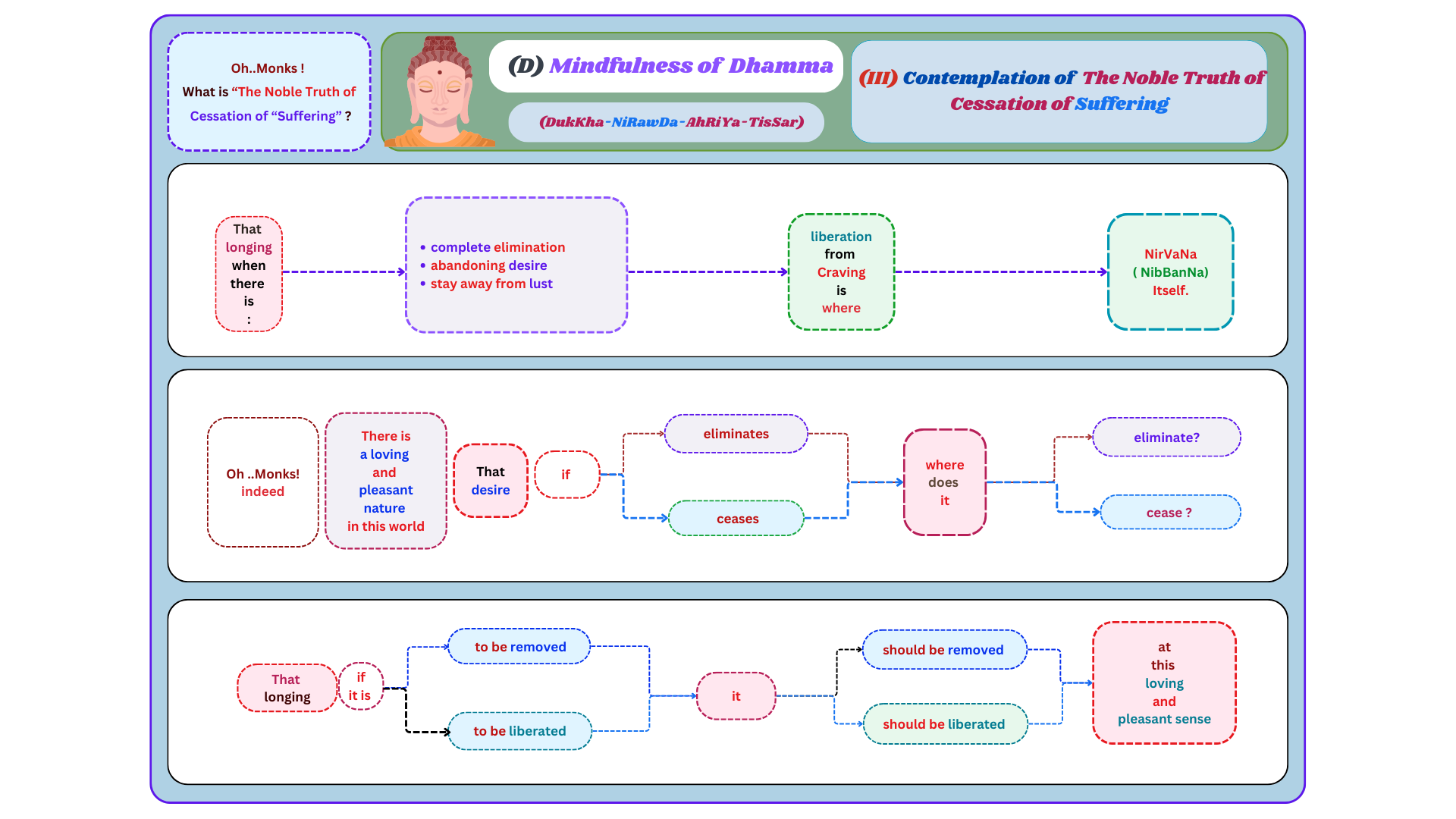
The cessation of suffering is the complete elimination and abandoning of craving—this state is Nirvana (Nibbana).

  1. Nirvana is found where craving is removed and liberated.
  2. It involves staying away from lust and the complete fading away of desire.
  3. By understanding where craving "dwells," the practitioner knows exactly where it must be extinguished.

How Suffering Ceases

Page 33

Page 33

Suffering ceases when craving is removed from the very places where it once originated.

  1. The practitioner removes attachment from the 6 sense organs and their respective objects.
  2. Elimination occurs through the cessation of "initial and sustained application" toward pleasant mental targets.
  3. "Loving and pleasant" here refers to any agreeable aspect of experience that the mind habitually grasps.

The Noble Eightfold Path (Magga)

Page 34

Page 34

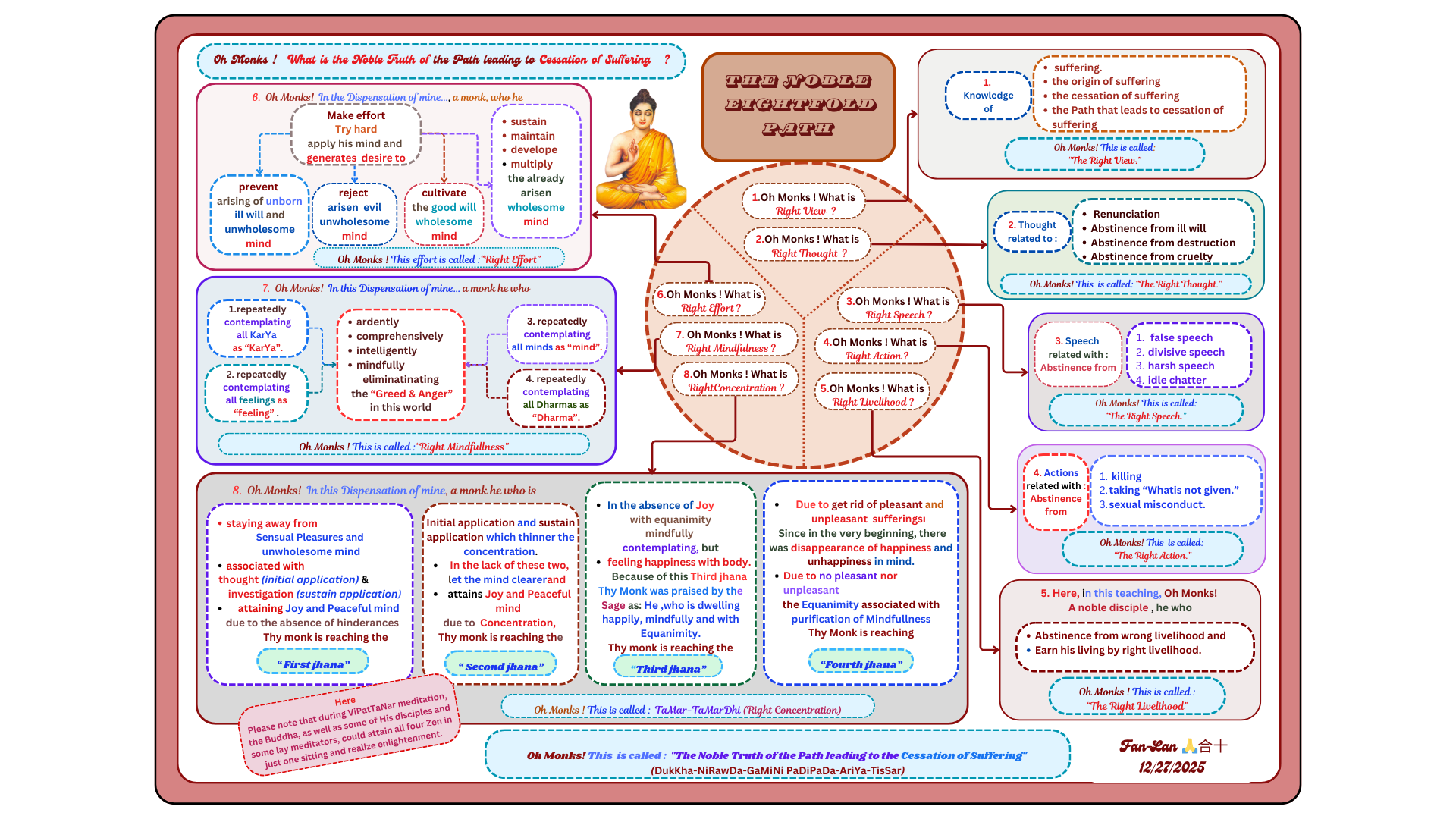
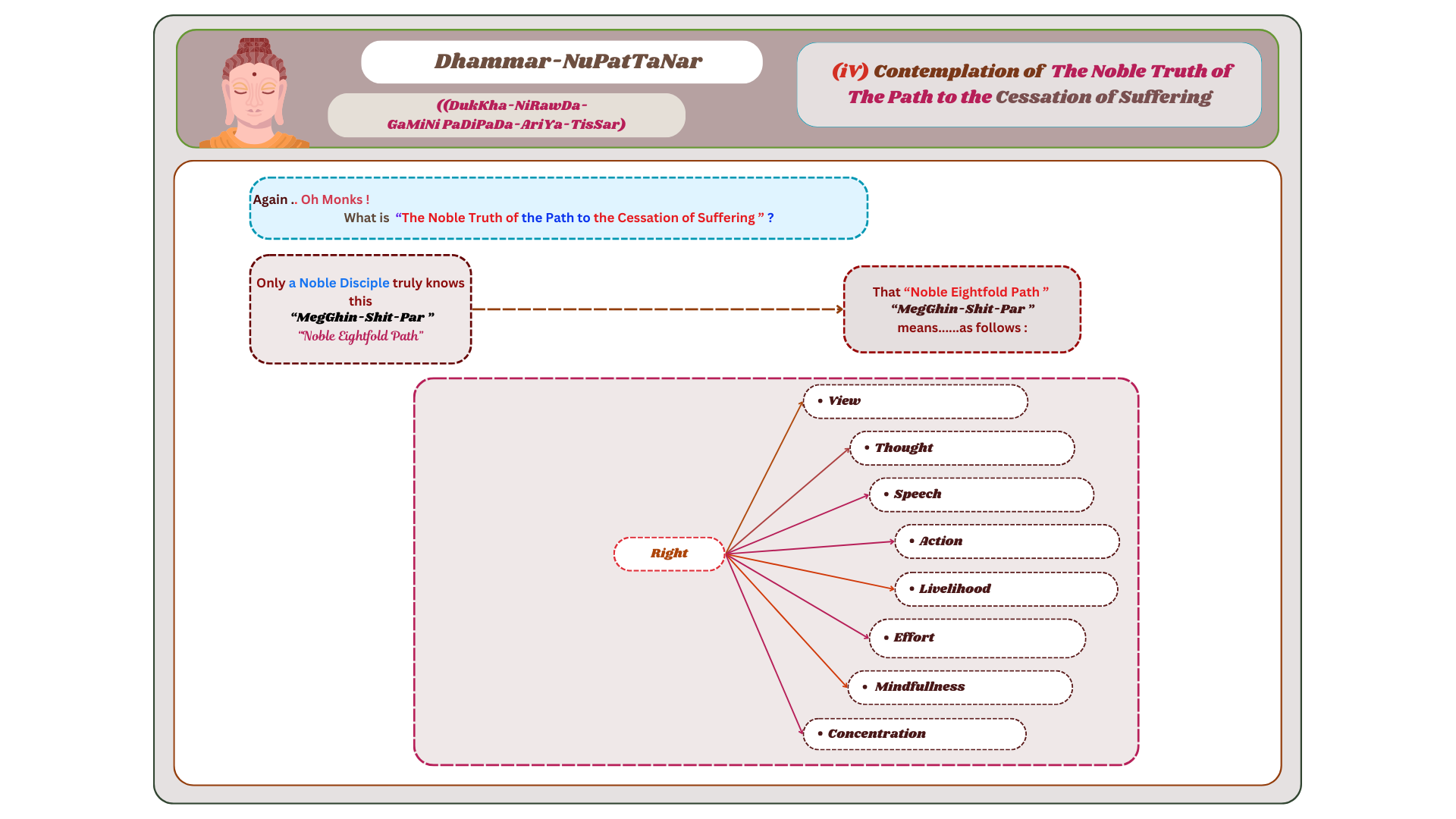
The "Only Way" to the cessation of suffering is the Eightfold Path, which a Noble Disciple (Ariya) must truly know.

  1. The Path consists of Right View, Right Thought, Right Speech, Right Action, Right Livelihood, Right Effort, Right Mindfulness, and Right Concentration.
  2. These eight factors are the practical tools for transitioning from suffering to liberation.

Detailed Breakdown of the Path and the 4 Jhanas

Page 35

Page 35

This page defines each of the eight path factors and introduces the levels of meditative absorption (Jhanas).

  1. Wisdom Group: Right View (knowledge of the 4 Truths) and Right Thought (renunciation, non-ill will).
  2. Morality Group: Right Speech, Action, and Livelihood (abstinence from killing, lying, and misconduct).
  3. Concentration Group: Right Effort, Mindfulness, and Concentration (attaining the four Jhanas from initial focus to pure equanimity).

Establishing Mindfulness in Reality
Page 36

Page 36

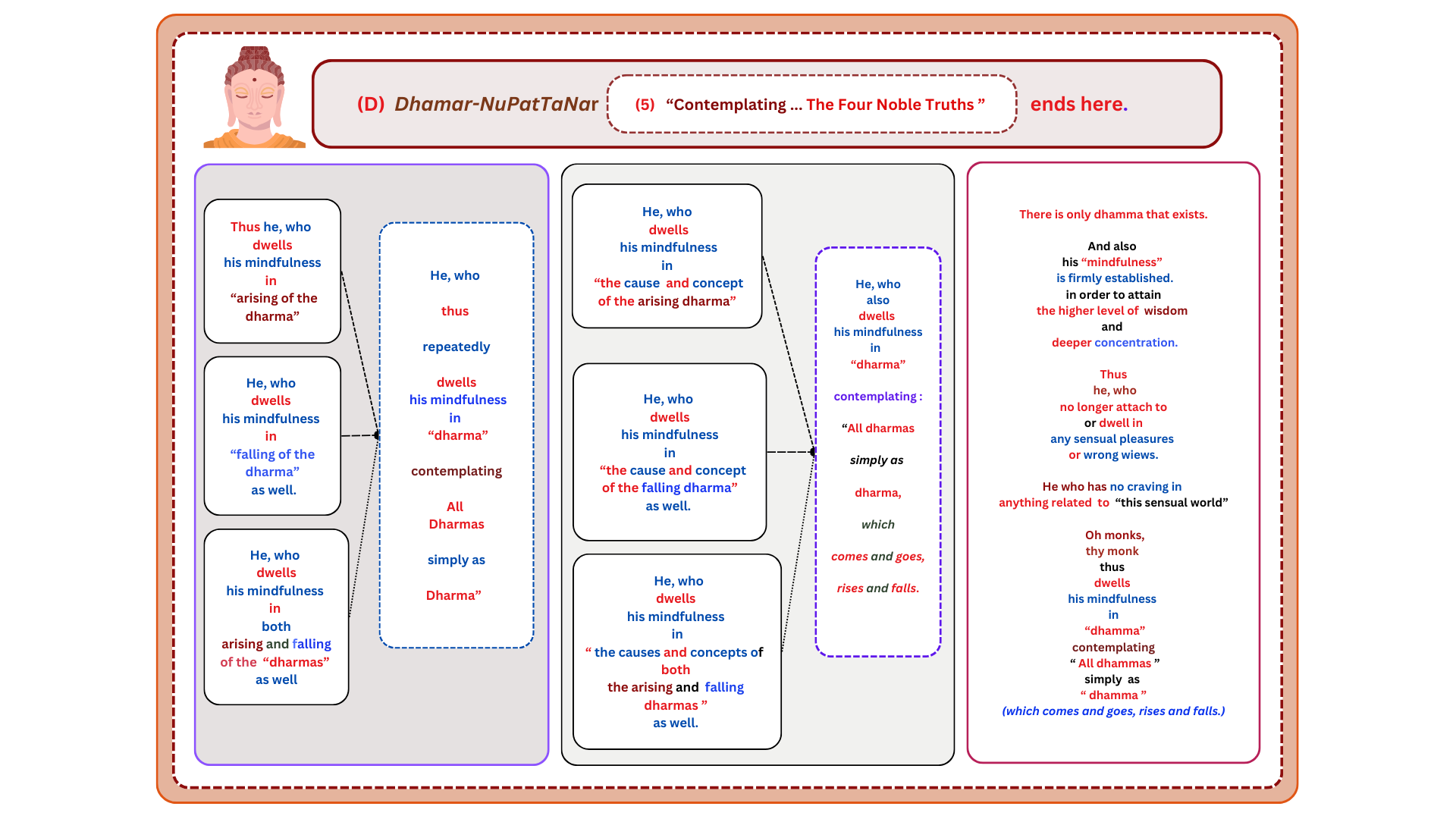
The conclusion of Dhamma contemplation: the mind must be firmly established to see things as they are.

  1. Observing the causes and concepts of the arising and falling of all phenomena.
  2. Developing a mind that no longer attaches to or dwells in sensual pleasures.
  3. Persistent mindfulness leads to the higher level of wisdom where one realizes there is only "Dhamma," not a "self."

The Buddha’s Declaration: Timeline for Success

Page 37

Page 37

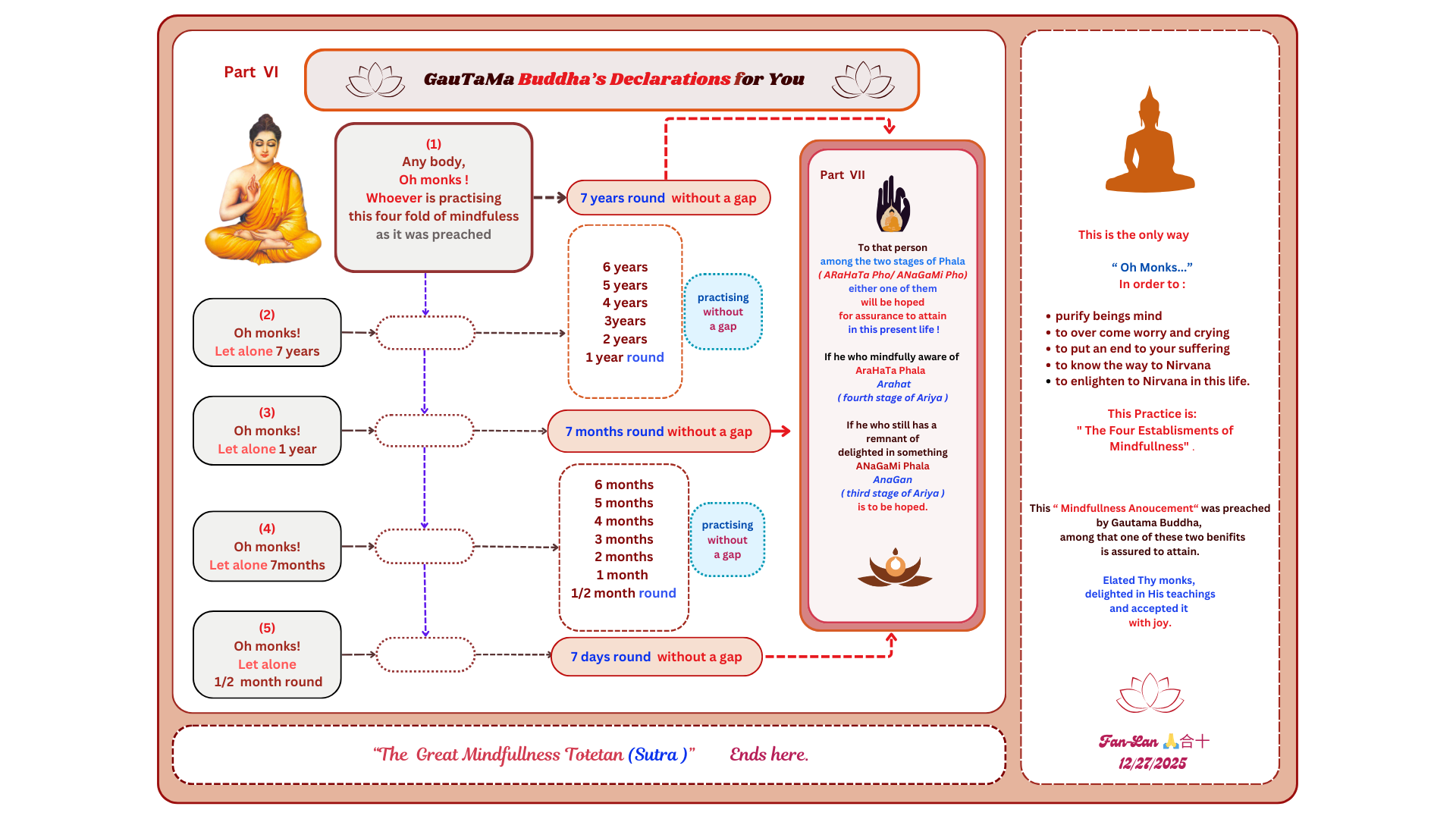
The Buddha guarantees that anyone practicing these four foundations of mindfulness correctly will see results within a specific timeframe.

  1. The timeframe ranges from 7 years down to just 7 days of continuous, gapless practice.
  2. Two results are possible: Full Enlightenment (Arahantship) or becoming a Non-returner (Anagami).
  3. This is the "only way" for the purification of beings and the end of suffering.

Practical Vipassana: Path and Fruition (Magga & Phala)

Page 38

Page 38

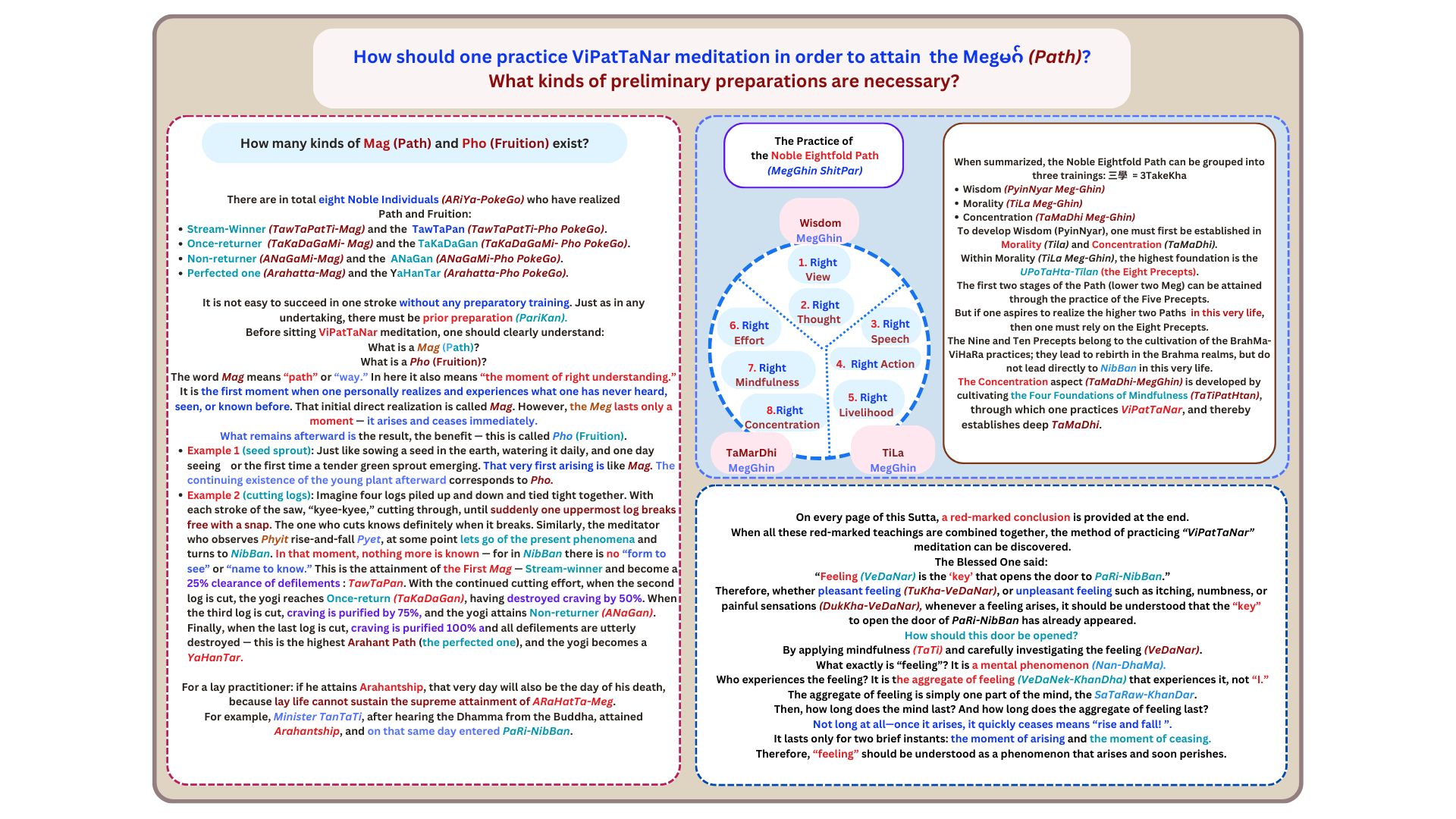
Practical advice on using "Feeling" as the key to open the door to Nirvana and understanding the stages of enlightenment.

  1. The "Key": Every feeling (pleasant or painful) is an opportunity to practice mindfulness. Feeling belongs to the mind, not the "I."
  2. Magga & Phala: "Mag" is the first moment of direct realization (like a seed sprouting); "Pho" is the resulting benefit.
  3. Four Stages: Stream-winner (25% pure), Once-returner (50%), Non-returner (75%), and Arahant (100% pure).

Conclusion: Knowledge of Things as They Truly Are

Page 39

Page 39

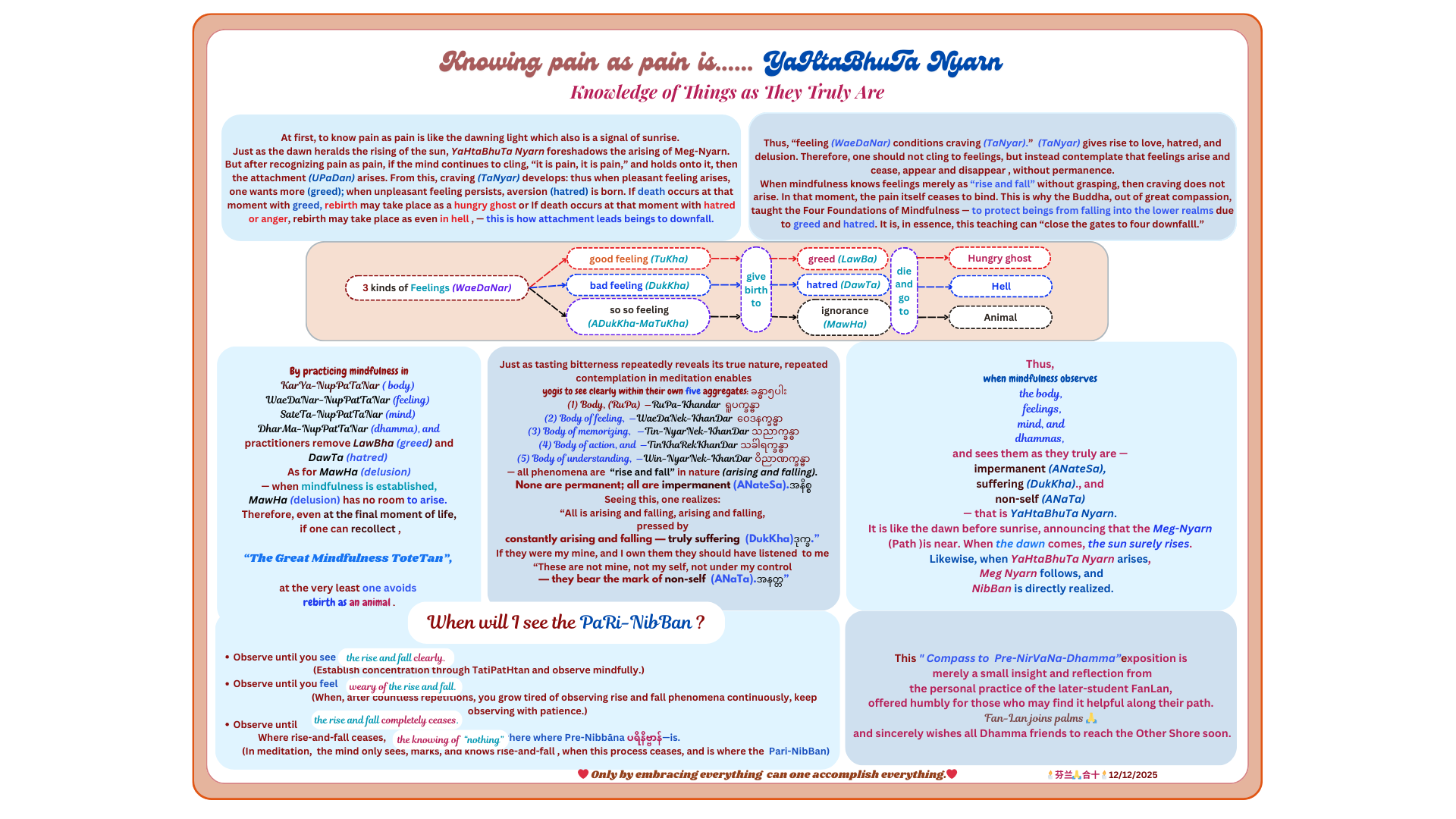
The final summary emphasizes seeing the marks of Impermanence, Suffering, and Non-self (Anicca, Dukkha, Anatta).

  1. Feeling conditions craving: If we don't observe "rise and fall," we react with greed (to pleasure) or hatred (to pain).
  2. Yathabhuta Nyarn: The "dawn before sunrise"—the knowledge that sees things as they truly are, leading directly to Nirvana.
  3. The Final Goal: Observe until you see the rise and fall, until you grow weary of it, and finally, until it completely ceases—that is Nibbana.

The Seven Factors of Enlightenment (Bojjhanga)

Page 40

Page 40

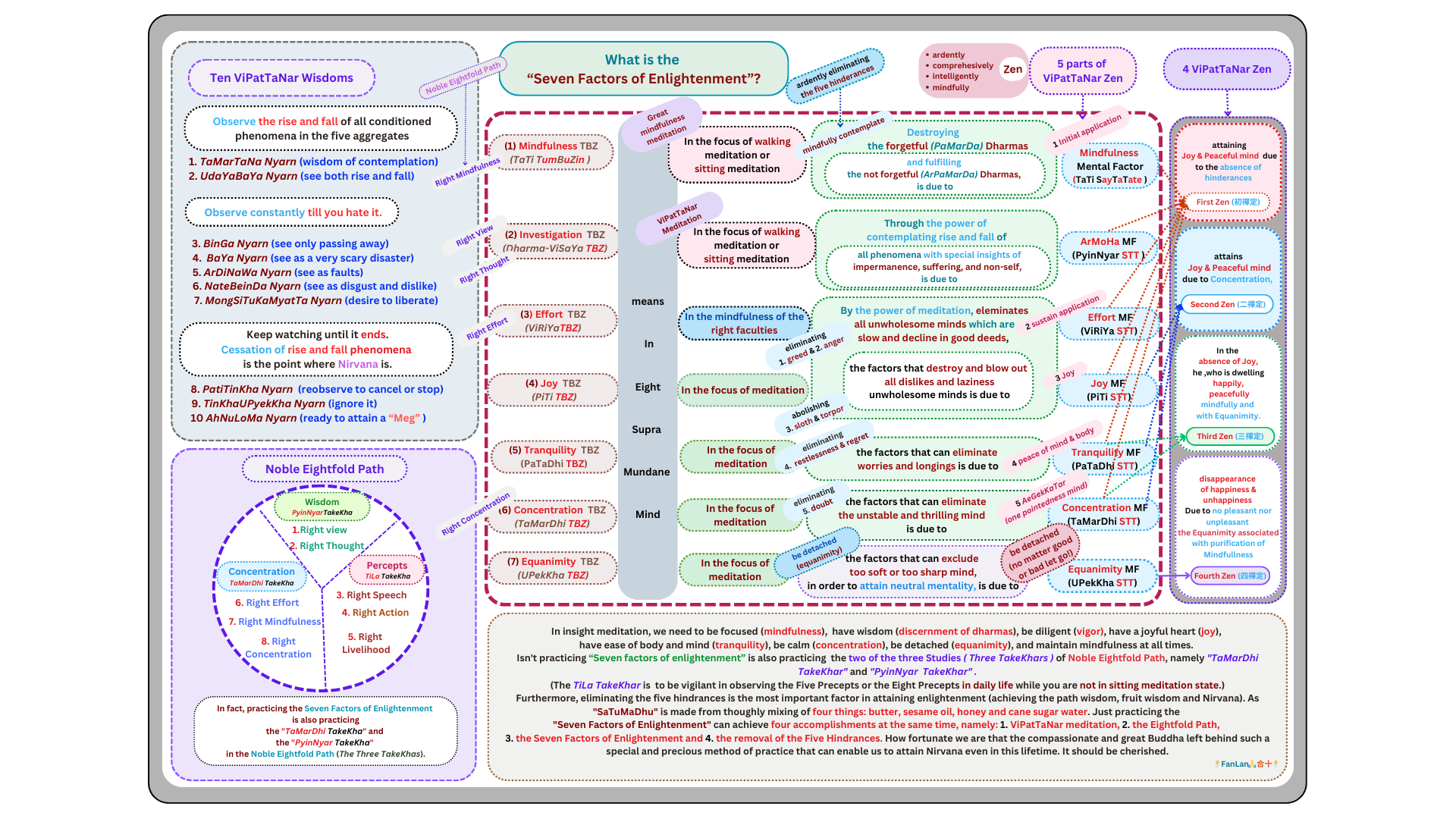
Practicing the Seven Factors of Enlightenment fulfills the Three Trainings: Morality (Sila), Concentration (Samadhi), and Wisdom (Panna).
  1. The Factors: Mindfulness, Investigation of Dhamma, Effort, Joy, Tranquility, Concentration, and Equanimity.
  2. The Synergistic Effect: Like "SaTuMaDhu" (a medicinal mixture), practicing these factors simultaneously achieves:
    • Vipassana Meditation
    • The Eightfold Path
    • The Seven Factors of Enlightenment
    • The removal of the Five Hindrances (Greed, Anger, Sloth, Restlessness, and Doubt).
  3. Vipassana Wisdoms: The page outlines the progression through 10 stages of insight, from the initial observation of rise and fall to the threshold of the Path (Magga).

The Seven Purifications (Visuddhi) - Part A

Page 41

Page 41

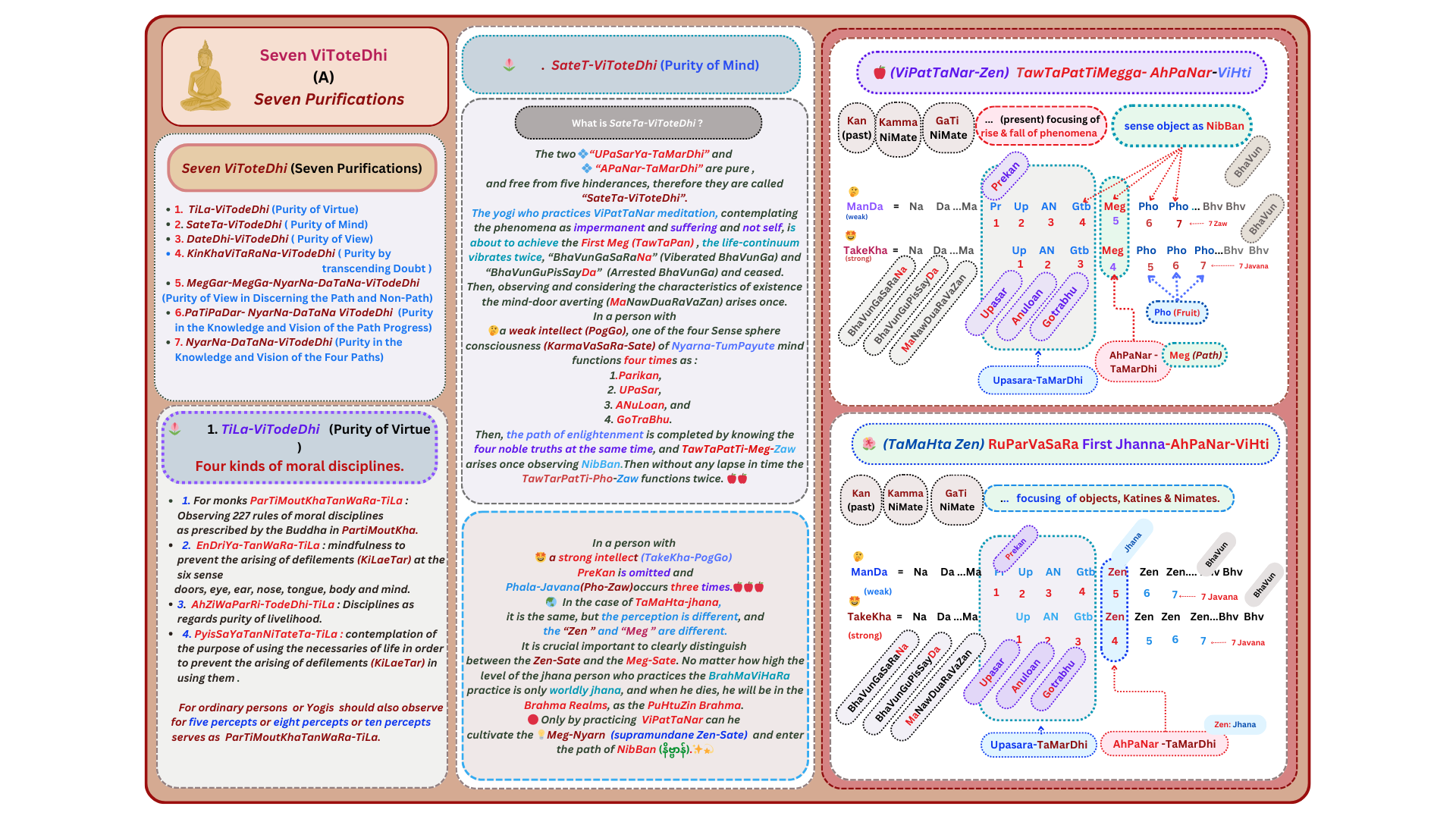
This page details the first two of the Seven Purifications necessary to reach Nirvana.

  1. Purity of Virtue (Sila-Visuddhi): For monks, this involves 227 rules; for laypeople, it is the 5, 8, or 10 precepts. It acts as the essential foundation.
  2. Purity of Mind (Citta-Visuddhi): This is the attainment of "Upasara-Samadhi" (Access Concentration) and "Appana-Samadhi" (Absorption Concentration).
  3. Path Cognitive Process: A technical diagram shows the "Mind-Door Cognitive Series" (Vithi) for both the Worldly Jhana and the Supramundane Path (Magga), illustrating how the mind transitions from worldly focus to the realization of Nibbana.
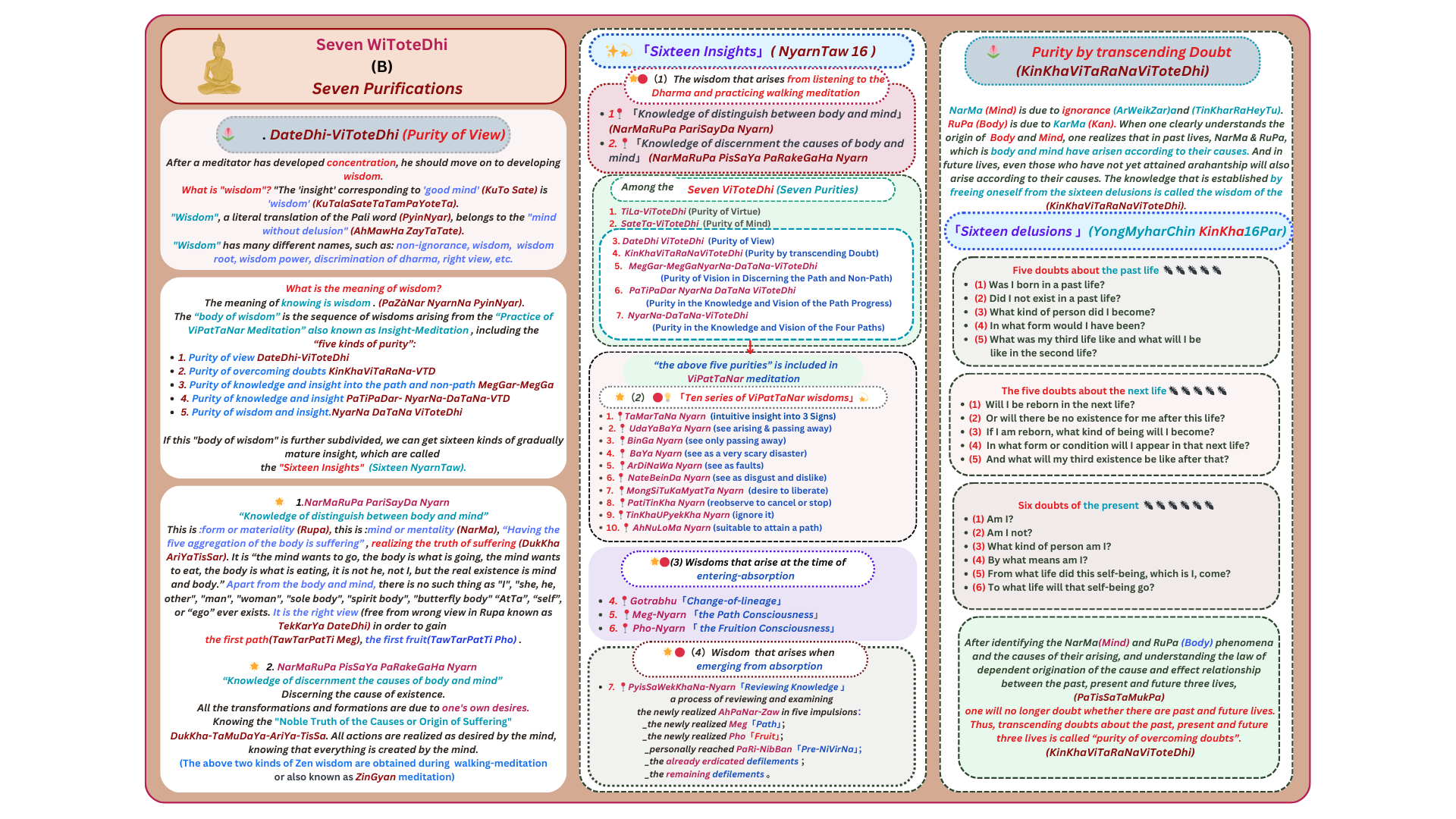
The Seven Purifications - Part B (View and Doubt)

Page 42

Page 42

Focuses on Purity of View and Purity by Transcending Doubt through the "Sixteen Insights" (NyarnTaw 16).

  1. Purity of View (Ditthi-Visuddhi): Distinguishing between Mind (Nama) and Body (Rupa). Understanding that there is no "self" or "ego," only mental and physical phenomena.
  2. Purity by Transcending Doubt (Kankhavitarana-Visuddhi): Overcoming the 16 types of delusions regarding the past, present, and future.
  3. The 16 Insights: Lists the progression of wisdom, starting from Nama-Rupa-Pariccheda-Nana (distinguishing body and mind) up to the Reviewing Knowledge after enlightenment.

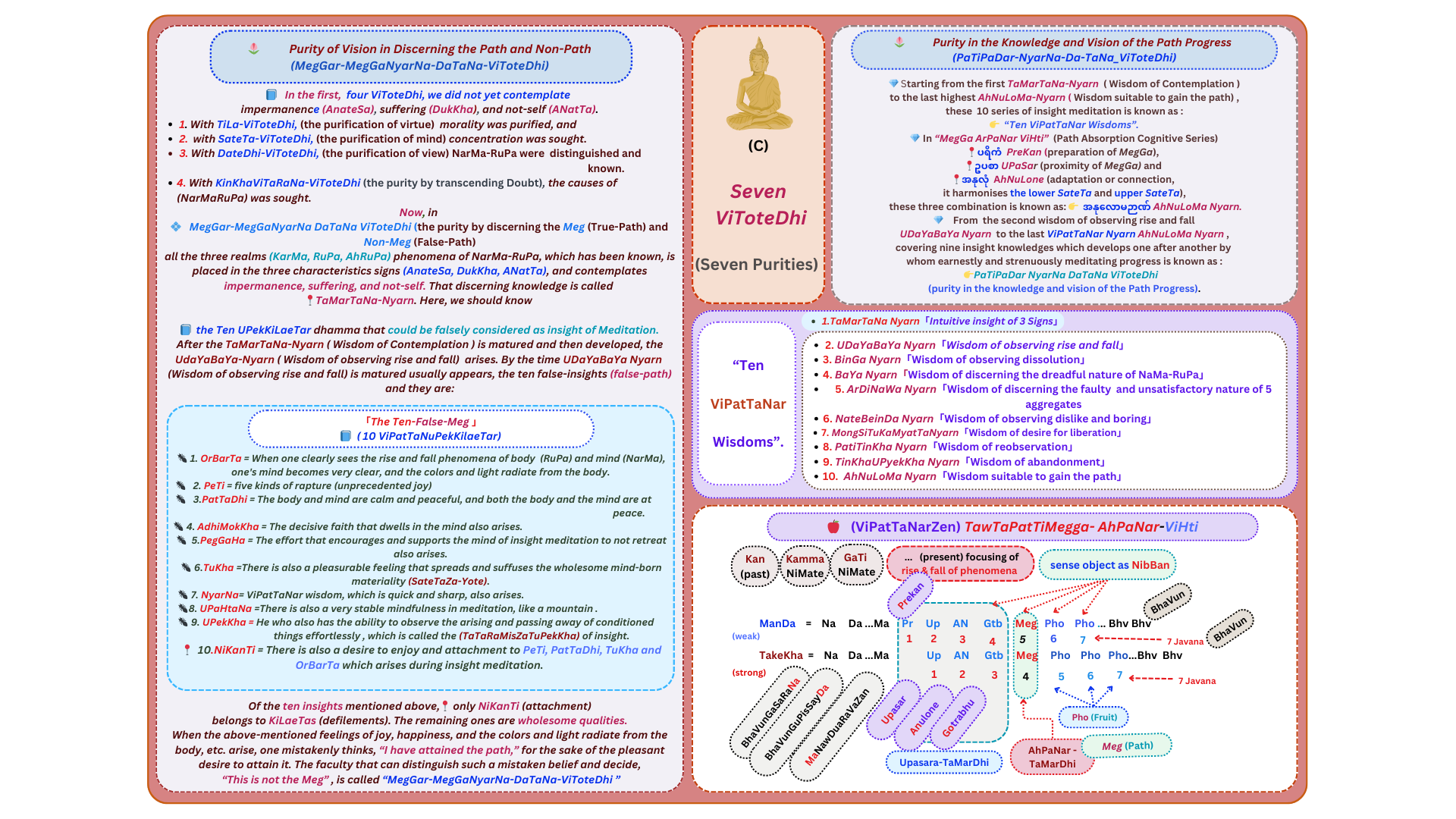
The Ten Vipassana Wisdoms and the Ten Imperfections

Page 43

Page 43

Explains how to distinguish the true path from the false "corruptions of insight."

  1. Purity of Knowledge and Vision of Path and Non-Path: As the meditator sees the "rise and fall" of phenomena clearly, they may experience light, joy, and peace (The 10 Upakkilesas).
  2. The "False Path": Attachment to these pleasant meditative experiences (like light or rapture) can become a "False Path." Wisdom is needed to decide: "This is not the Path."
  3. The Progression: Moving through the 10 Vipassana Wisdoms, including the knowledge of dissolution (Bhanga) and the desire for liberation (Muncitukamyata).

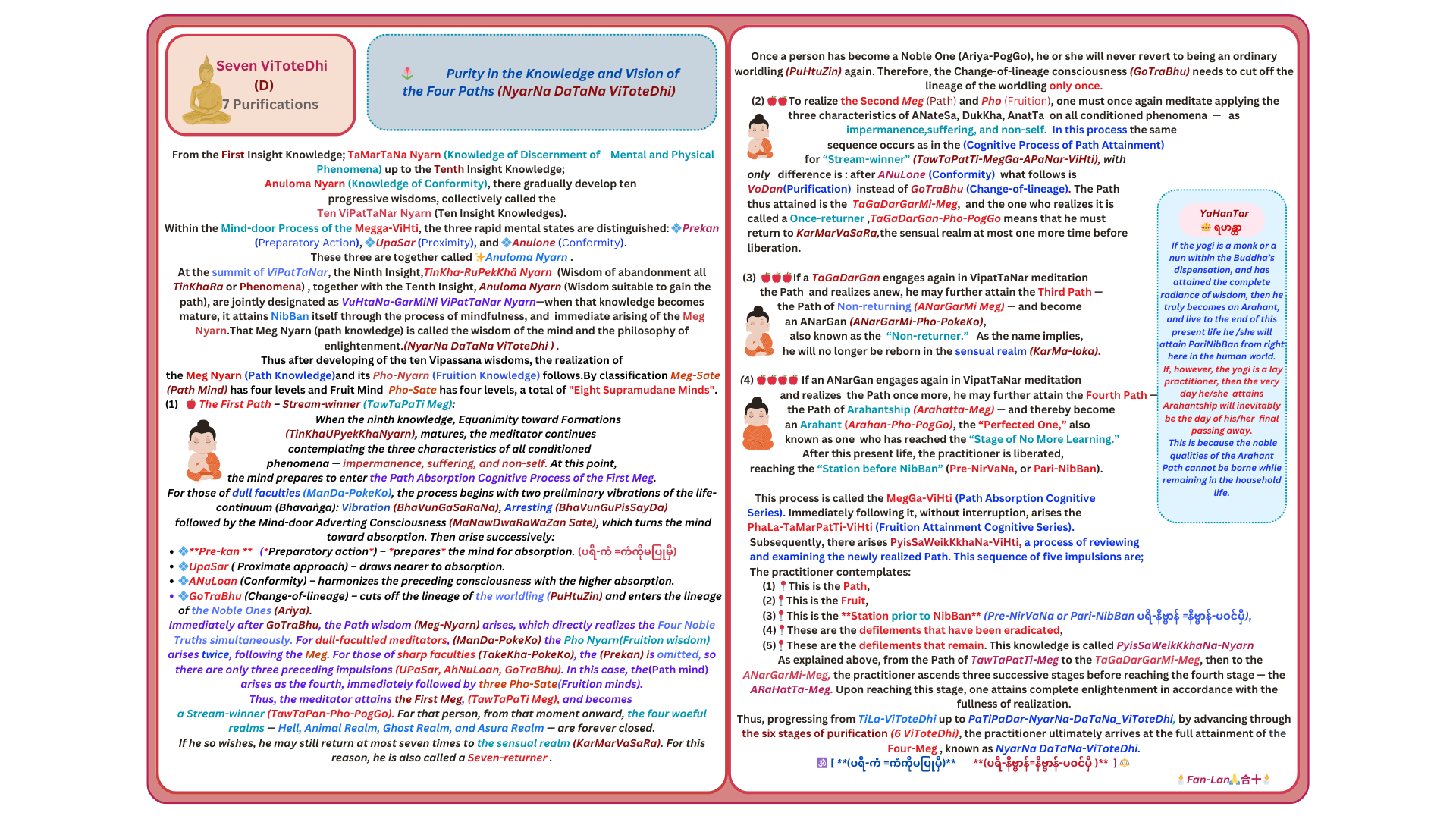
Purity of Knowledge and Vision (The Four Paths)

Page 44

Page 44

The final stage: attaining the four levels of supramundane Path and Fruition (Magga and Phala).

  1. Stage 1 - Stream-winner (Sotapanna): The first glimpse of Nibbana. Closes the doors to the four woeful realms (hell, animal, ghost, asura).
  2. Stage 2 - Once-returner (Sakadagami): Returns to the sensual realm at most one more time.
  3. Stage 3 - Non-returner (Anagami): Will not be reborn in the human or sensual world.
  4. Stage 4 - Arahant: The "Perfected One" who has eradicated all defilements. This is the stage of "No More Learning."
  5. Lay Life vs. Monkhood: If a layperson reaches Arahantship, the notes state they must enter the monkhood or pass away that same day, as the lay life cannot sustain such supreme purity.

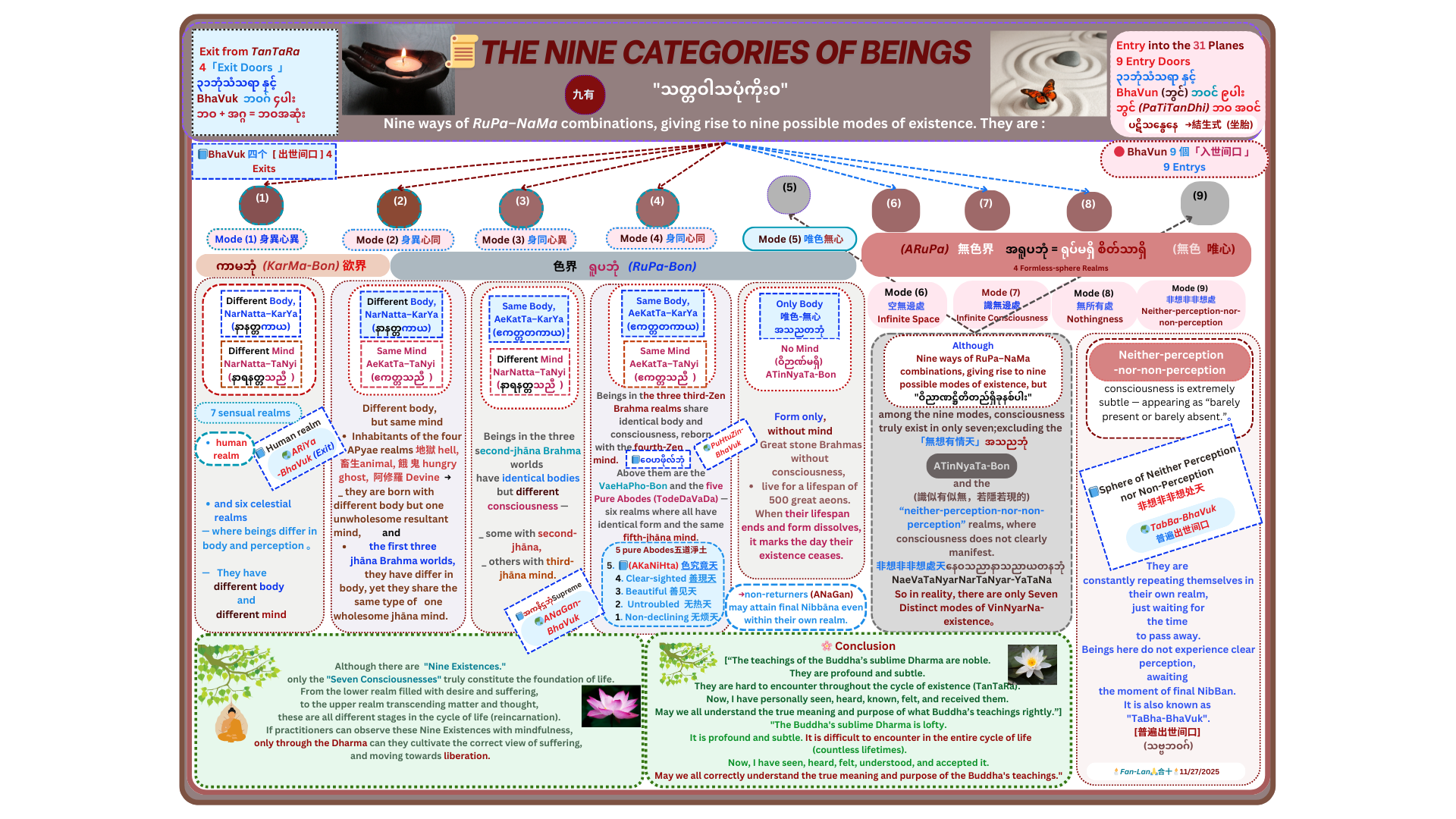
The Nine Categories of Beings (Sattavasa)

Page 45

Page 45

Outlines the nine possible modes of existence based on Rupa (Form) and Nama (Mind) combinations.

  • The Nine Modes:
    • Mode 1: Different body, different mind (Human and celestial realms).
    • Mode 2: Different body, same mind (Apyae realms and first three jhana Brahma worlds).
    • Mode 3: Same body, different mind (Second-jhana Brahma worlds).
    • Mode 4: Same body, same mind (Third-jhana Brahma realms and Pure Abodes).
    • Mode 5: Form only, without mind (Great stone Brahmas).
    • Modes 6-9: The four Formless (Arupa) realms: Infinite Space, Infinite Consciousness, Nothingness, and Neither-perception-nor-non-perception.

Conclusion: Consciousness truly exists in only seven of these nine modes. Practitioners must observe these states with mindfulness to cultivate the correct view of suffering.

The Four Origins of Life and Body Formation

Page 46

Page 46

Explains the four ways beings enter existence and the physical development within the womb.

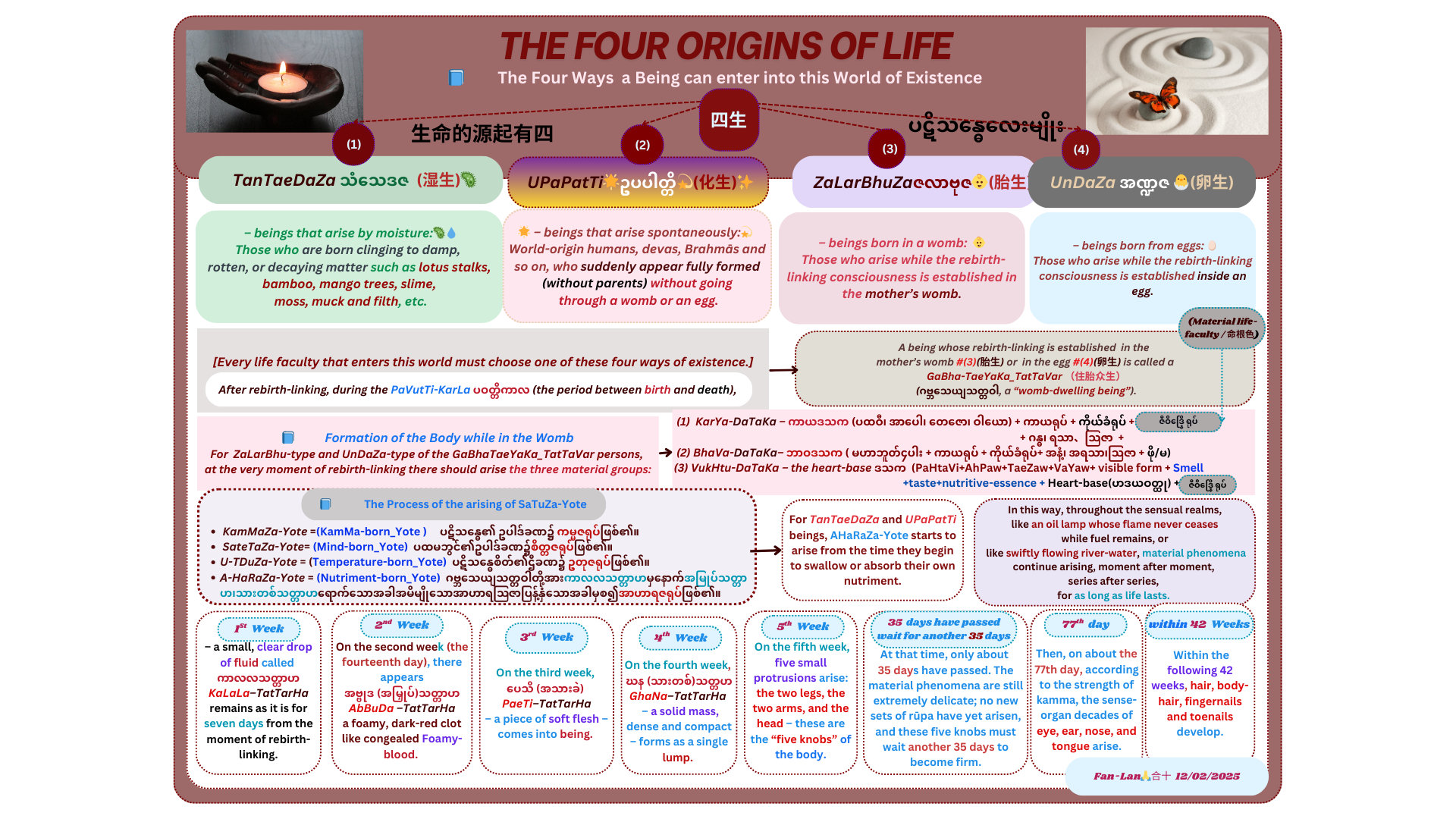
  1. The Four Origins: Beings born in a womb (ZaLarBhuZa), from eggs (UnDaZa), from moisture (TanTaeDaZa), or spontaneously (UPaPatTi).
  2. Formation in the Womb:
    • Week 1: Kalala (small clear drop).
    • Week 2: Abbudha (foamy, dark-red clot).
    • Week 3: Pesi (piece of soft flesh).
    • Week 4: Ghana (solid mass/lump).
    • Week 5: Pasakha (five knobs: head, two arms, two legs).
  3. Sense Organs: On the 77th day, the sense-organ decades of eye, ear, nose, and tongue arise according to the strength of kamma.
[Image of human fetal development stages]

The Ten Series of Vipassana Wisdoms

Page 47

Page 47

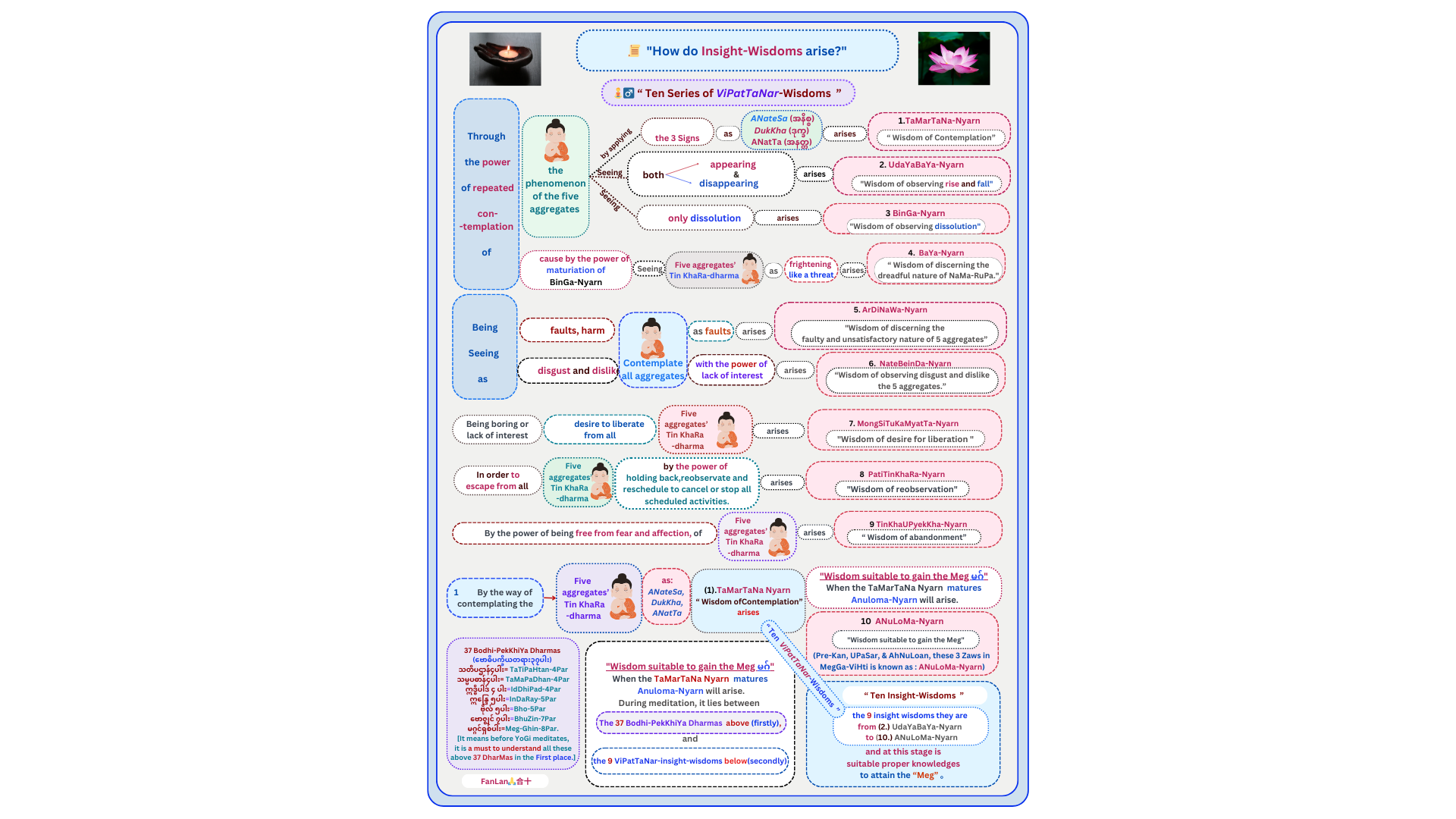
Describes the systematic progression of insight-wisdom required to reach enlightenment (Magga).

  • Preparation: One must first understand the 37 Bodhi-Pekkhiya Dharmas (Foundations of Mindfulness, Right Efforts, etc.).
  • The Insights: Progression from observing "Rise and Fall" (Udayabbaya) to "Dissolution" (Bhanga), followed by "Fear" (Baya), "Faults" (Adinava), "Disgust" (Nibbida), and "Desire for Liberation" (Muncitukamyata).
  • The Path: The process culminates in Sankharupekkhanyarn (Equanimity toward formations) and Anuloma-nyarn (Adaptation knowledge), which leads to the "Meg" (Path).

The Four BhaVuk (Exit Points from Samsara)

Page 48

Page 48

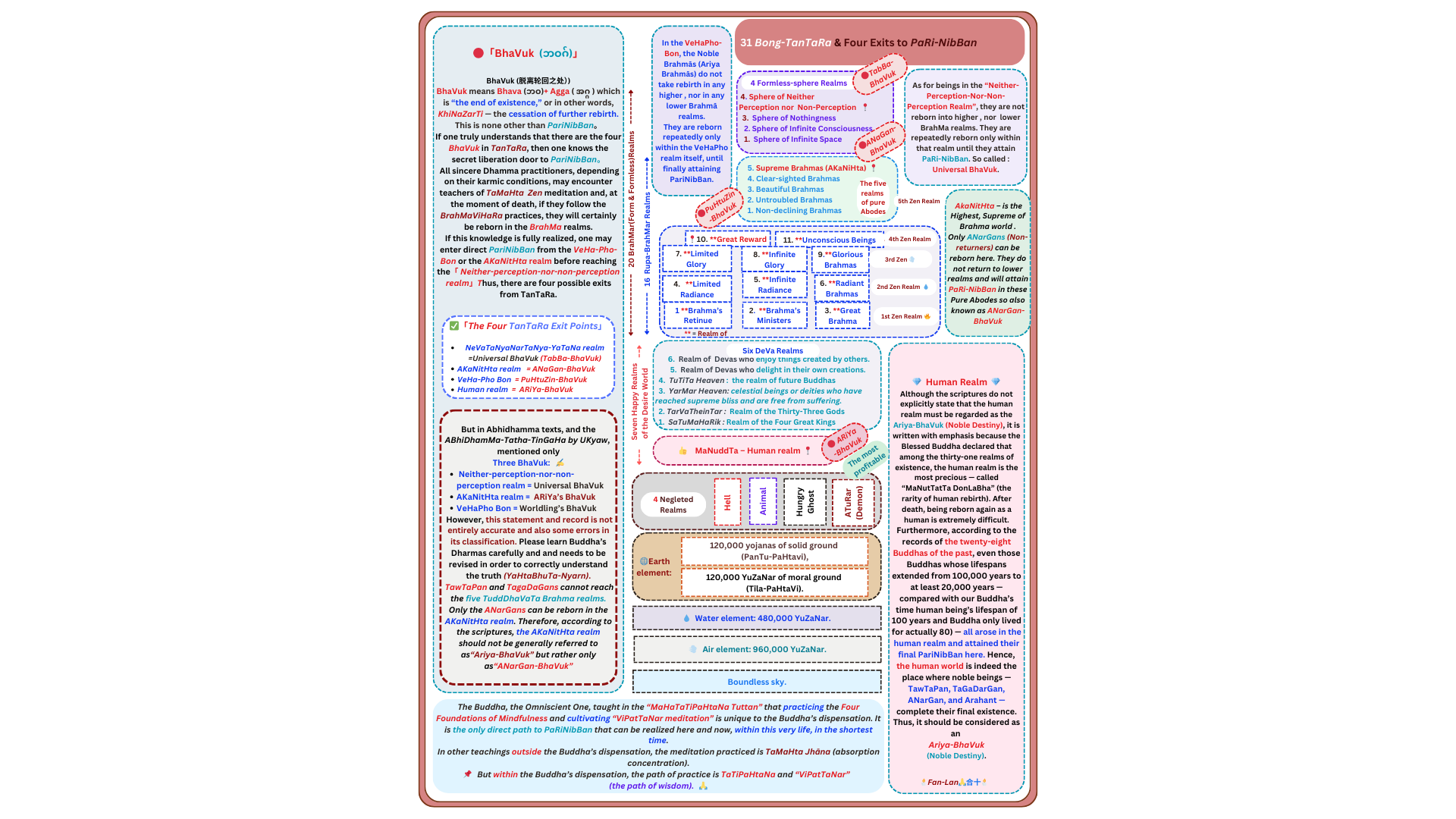
Defines "BhaVuk" as the end of existence or cessation of further rebirth (PariNibBan).

  • The Four TanTaRa Exit Points:
    1. Human Realm (ARiYa-BhaVuk): The most precious realm where Buddhas arise and complete their final existence.
    2. VeHa-Pho Bon (PuHtuZin-BhaVuk): For worldlings who reach high meditative states.
    3. AKaNitHta Realm (ANaGan-BhaVuk): The supreme Brahma world for Non-returners.
    4. Neither-Perception Realm (TabBa-BhaVuk): The universal exit point for those awaiting final Nibbana.
  • Crucial Distinction: Practice of Vipassana is the only direct path to realization within this very life, distinct from mere absorption concentration (Jhana).

Author's Afterword

Page 49

Page 49

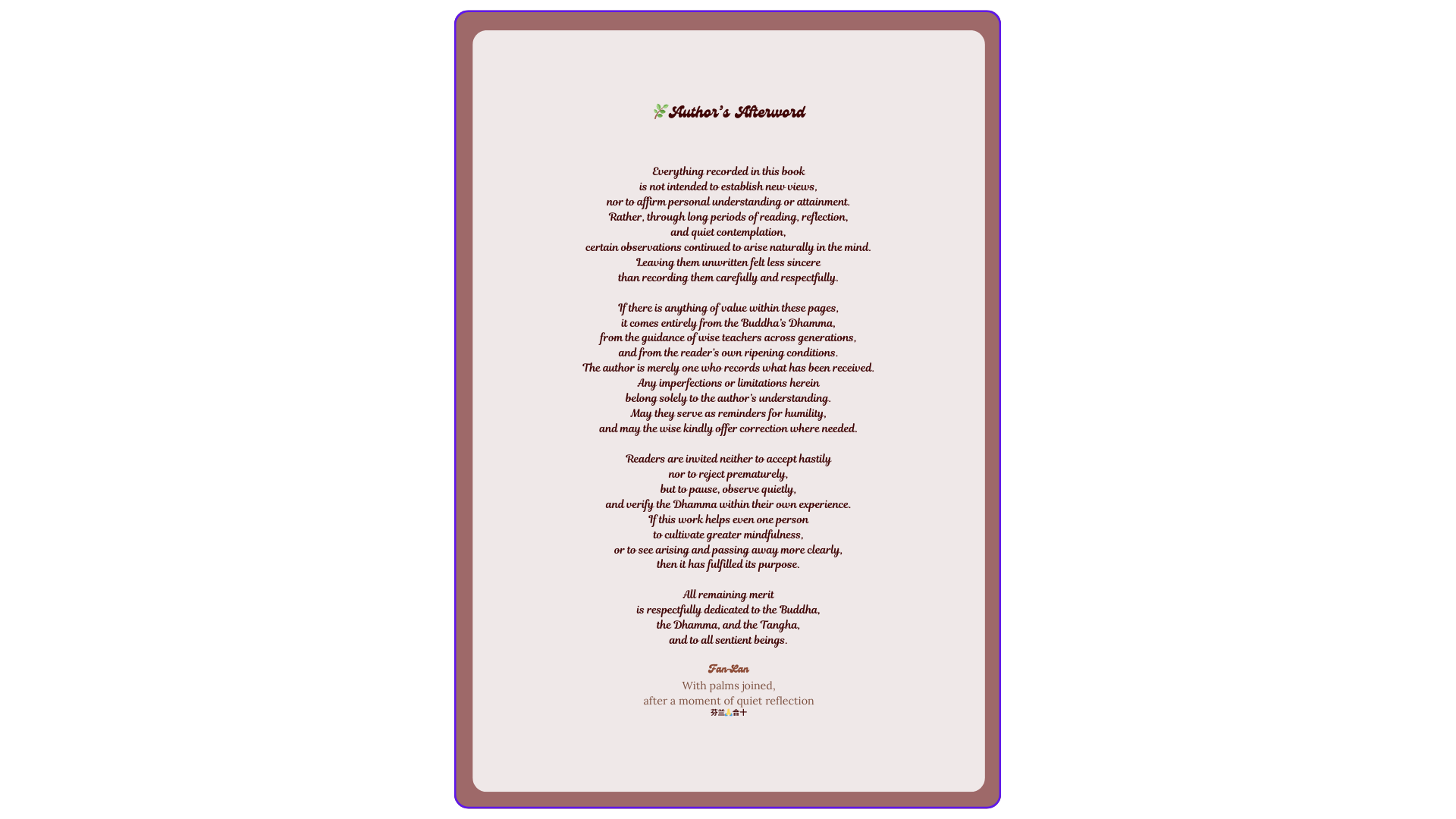
A final reflection from Fan-Lan regarding the recording of these teachings.

"Everything recorded in this book is not intended to establish new views... The author is merely one who records what has been received. Any imperfections or limitations belong solely to the author’s understanding."

The work serves to help cultivators see arising and passing away more clearly. Merit is dedicated to the Buddha, Dhamma, Tangha, and all sentient beings.

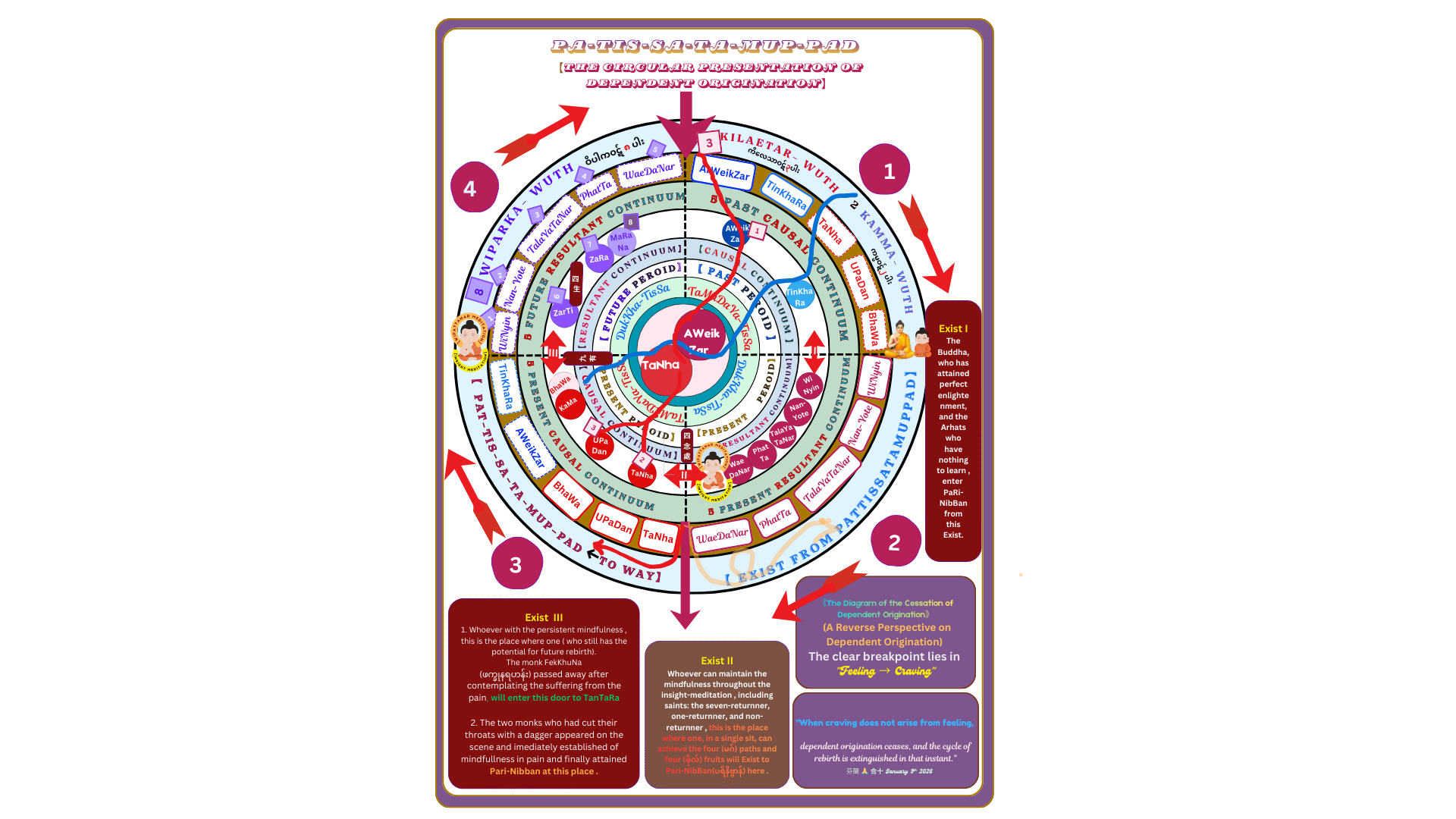
Dependent Origination and the Three Exits

Page 50

Page 50

Visual and conceptual summary of Paticcasamuppada (Dependent Origination) and the methods of escape.

  • The Breakpoint: "When craving does not arise from feeling, dependent origination ceases, and the cycle of rebirth is extinguished."
  • The Three Exits:
    • Exist I: For the Buddha and Arhats who have nothing more to learn.
    • Exist II: For Saints (Non-returners, etc.) who maintain mindfulness throughout insight-meditation.
    • Exist III: For those who attain liberation by establishing mindfulness in pain and suffering at the moment of passing (e.g., the monk Fekkuna).